
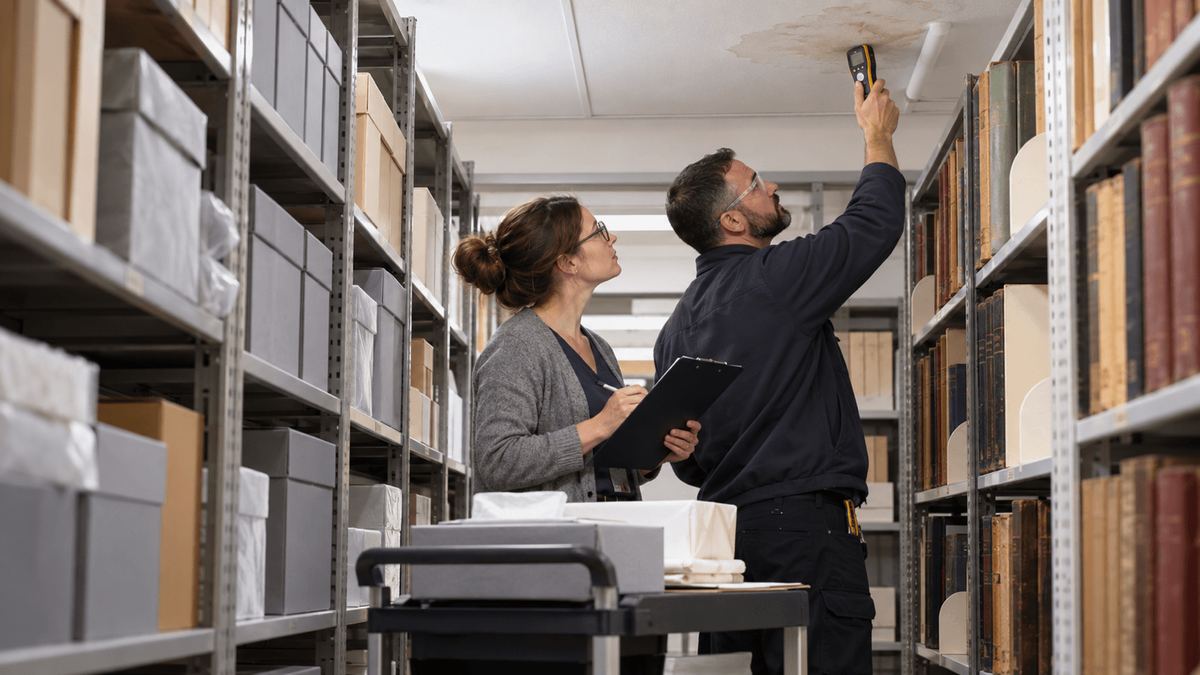
Libraries and archives need a coordinated moisture response because small leaks and humidity changes can threaten buildings, books, records, and staff routines.
A wet ceiling tile over shelving, condensation near an exterior wall, a plumbing leak in a storage room, or an HVAC outage can create two related problems. The facility must protect occupants and building materials while collection staff make careful decisions about books, documents, photographs, or artifacts. Improvised handling can spread moisture, damage fragile items, or interfere with a qualified assessment.
Training gives facilities, property, custodial, security, and collections teams a shared first-response framework. It does not turn routine staff into mold remediators or conservators. Each organization should pair general awareness with its emergency plan, collection priorities, insurance requirements, vendor arrangements, and state or local rules.
Why Libraries and Archives Need a Moisture Plan
Libraries and archives combine occupied spaces, porous building materials, dense shelving, paper-based collections, mechanical systems, and areas that may receive little daily traffic. Water can travel behind walls, beneath flooring, along piping, or through stacked materials before someone sees it. High humidity can affect a wider area than the visible leak.
Paper, cardboard, adhesives, textiles, wood, carpet, ceiling tile, and gypsum board can retain moisture. Collection materials may be unique, irreplaceable, confidential, or difficult to replace. A response that is acceptable for an ordinary office document may be inappropriate for a rare book, historical record, photograph, or archival box.
A written plan helps teams move quickly without rushing into the wrong action. It can define who stops the source, who controls access, who evaluates building systems, who sets collection priorities, who contacts a conservator or recovery vendor, and who communicates with staff and the public. The plan should also identify alternates for nights, weekends, and holidays.
Build the Response Around Detection and Handoffs
Early reporting matters. Staff should know how to report odors, staining, condensation, active leaks, damp materials, ceiling changes, wet carpet, HVAC alarms, or unexpected humidity readings. Reports should identify the exact location, time observed, visible extent, nearby collections, and immediate hazards without claiming that mold is present unless appropriately determined.
The first responder should protect people before property. Electrical hazards, unstable ceiling materials, contaminated water, slip hazards, structural concerns, and respiratory risks may require isolation or emergency assistance. Staff should not enter a hazardous area merely to save a book. The emergency plan should establish who can shut water, electricity, or equipment down and under what conditions.
Once immediate hazards are controlled, the team should stop or contain the moisture source when it can do so safely. That may require facilities staff, a plumber, roofer, HVAC technician, fire protection contractor, or other qualified person. Documenting the source and repair is more useful than repeatedly drying the same area without addressing the cause.
Collection and facility decisions should then be coordinated. Moving dry collections away from a leak may prevent damage, but moving damp or visibly affected materials through clean areas can create cross-contamination or tracking concerns. A collection professional or recovery specialist can advise on isolation, packing, drying, freezing, conservation, replacement, or disposal based on material and scale.
The handoff record should include the discovery time, source, affected rooms, building materials, collection types, environmental readings, photographs, access controls, actions, vendors, removed items, storage locations, and follow-up owner.
Moisture Checks That Support Better Decisions
Routine building rounds can include roof and plumbing areas, exterior walls, windows, floor drains, basements, mechanical rooms, storage rooms, and spaces below water lines. Staff should look for recurring stains, damaged seals, condensation, blocked drainage, damp odors, corroded fittings, and items stored directly on floors. Findings should enter a work-order system with a clear owner.
Environmental monitoring can help identify changes, but the organization should define how instruments are placed, maintained, read, and reviewed. A single humidity reading does not describe conditions behind shelving or inside a box, and a sensor can drift or lose data. Trend review, equipment checks, and physical inspection should work together.
Moisture meters and thermal imaging can support investigation when used by trained people who understand the equipment and materials. Readings should be documented with location, material, instrument, settings or mode, and comparison points. A number without context should not be treated as proof that an area is dry or free of mold.
After a leak or humidity event, teams should define closure criteria appropriate to the incident. These may include source repair, removal or drying decisions, inspection of affected materials, stable environmental conditions, completion of specialized work, cleanup, documentation, and management approval. A visual check alone may not answer every question, while testing should not be used as a universal pass-fail shortcut.
Common Mistakes and Misconceptions
One misconception is that paper begins growing mold at one universal hour. Growth depends on moisture, temperature, material, airflow, contamination, and other conditions. Prompt action is important, but a simple clock cannot guarantee that growth has or has not occurred. Record times and conditions, then use appropriate professional guidance.
Another mistake is lowering temperature while ignoring relative humidity and moisture sources. Temperature and relative humidity interact, and cooling without moisture control can contribute to condensation in some conditions. Building and collection professionals should evaluate the system rather than relying on a single thermostat adjustment.
Do not aim fans at visibly affected materials without a plan. Air movement may help some drying operations, but it can also spread spores or contaminants and can affect fragile items. Determine isolation, airflow, and work-area needs with qualified guidance.
Avoid spraying bleach or another chemical on books, records, porous building materials, or collection objects as a default response. Products can damage materials, create exposure concerns, fail to address moisture, and conflict with conservation procedures. Cleaning and treatment decisions should match the material and be made by appropriately qualified people.
Do not assume that a musty odor identifies the source, species, or extent of a problem. Treat it as a reason to investigate moisture and inspect conditions. Likewise, color does not establish toxicity or determine the response by itself.
Do not discard collection items before checking authority, retention schedules, donor restrictions, insurance needs, and conservation options. Conversely, do not keep unsalvageable wet material in occupied or clean storage areas while decisions remain undocumented.
Do not claim that an online certificate authorizes regulated mold work. Training can build awareness and documentation skills, but licensing and work rules vary by state and locality.
How Training Helps
Role-based training helps staff act within clear limits. Front-desk and security staff can learn reporting and access-control procedures. Custodial staff can learn when routine cleaning stops and escalation begins. Facilities staff can practice shutoffs, moisture documentation, and vendor handoffs. Collection staff can direct priorities and specialized material decisions.
Supervisors can use scenarios to test coordination. Begin with a leaking pipe above general stacks, then add a wet archival box, an electrical concern, a closed mechanical room, and a public event scheduled nearby. Ask who controls the area, who stops the source, how collections are protected, what is photographed, who contacts vendors, and who approves reopening.
Training should address personal protective equipment without suggesting that one setup fits every event. Hazards, contamination, extent, tasks, and applicable rules determine protection. Staff who are not trained or equipped for remediation should preserve distance, control access, and obtain qualified help.
The Mold Prevention and Remediation Awareness course available through moldtraining.us can provide a general foundation for property and facility teams. Organizations should supplement it with library-specific emergency procedures, collection priorities, hands-on building orientation, communication protocols, and any training required for assigned work.
Courses provide certificates of completion. They do not guarantee licensure, authorize regulated work, or guarantee acceptance by an employer or agency. Learners and organizations should check current state and local requirements and match training to actual duties.
Frequently Asked Questions
Does high humidity mean mold is already growing?
No. High humidity can create conditions that support growth and damage, but it does not by itself prove that mold is present. Review trends, inspect materials and building conditions, identify moisture sources, and obtain qualified help when needed.
Can staff use household mold test kits on books?
Routine test kits may not answer the important questions about source, extent, material condition, or response. Begin with moisture investigation, physical inspection, environmental control, and appropriate professional guidance. Testing should have a defined purpose and qualified interpretation.
Should wet books be placed in plastic bags?
There is no universal packing method for every material and situation. Sealing wet items without a recovery plan may trap moisture. Contact a collections recovery professional or conservator and follow the organization's disaster plan for isolation, packing, labeling, transport, drying, or freezing.
Can a dehumidifier solve the problem?
A dehumidifier may be part of a response when selected and operated appropriately, but it does not repair a leak, remove damaged material, evaluate collections, or prove completion. Capacity, drainage, electrical safety, temperature, airflow, and monitoring all matter.
When should a library call a specialist?
Seek qualified help when the source is hazardous or unclear, the affected area is extensive, building systems are involved, sensitive or valuable collections are wet, visible growth is present, conditions recur, or staff lack appropriate equipment and training. The emergency plan should list contacts in advance.
Does a moldtraining.us certificate make someone a licensed mold professional?
No. The courses provide certificates of completion and do not guarantee licensure or authorization to perform regulated work. Check state and local requirements and employer policies for the location and assigned duties.
A Practical First Review
Walk one public area, one collection storage area, and one mechanical or service area with facilities and collection staff. Locate water shutoffs, roof drains, piping, sensors, exterior walls, floor drains, electrical concerns, emergency supplies, and priority collections. Verify that contacts and access procedures work after hours.
Then sample the last three leak, humidity, roof, plumbing, or HVAC work orders. Check whether each record identifies the source, affected materials, environmental readings, access controls, repair, drying or removal decision, collection handoff, closure review, and follow-up owner. Update the response form where the chain breaks.
Consider adding the relevant moldtraining.us awareness course to onboarding or refresher training for facility and property staff. Keep the invitation soft and practical: online learning can support a shared foundation, while building-specific drills and qualified collection guidance make that knowledge usable.
Conclusion
Libraries and archives protect more than buildings. A coordinated moisture response can help preserve collections, support occupant safety, reduce confusion, and create a defensible record of decisions. The strongest plans connect early reporting, source control, environmental monitoring, collection expertise, vendor support, training, and documented closure.
Sources
U.S. Environmental Protection Agency, Mold Remediation in Schools and Commercial Buildings Guide | https://www.epa.gov/mold/mold-remediation-schools-and-commercial-buildings-guide
U.S. Environmental Protection Agency, Moisture Control Guidance for Building Design, Construction and Maintenance | https://www.epa.gov/indoor-air-quality-iaq/moisture-control-guidance-building-design-construction-and-maintenance
Centers for Disease Control and Prevention, Mold | https://www.cdc.gov/mold-health/about/index.html
U.S. National Park Service, Preservation Matters: Disasters, Mold on Cultural Resources and Collections | https://www.nps.gov/articles/000/preservation-matters-disasters-mold-on-cultural-resources-and-collections.htm
U.S. National Park Service, Conserve O Grams: Museums and Collections | https://www.nps.gov/subjects/museums/conserve-o-grams.htm