
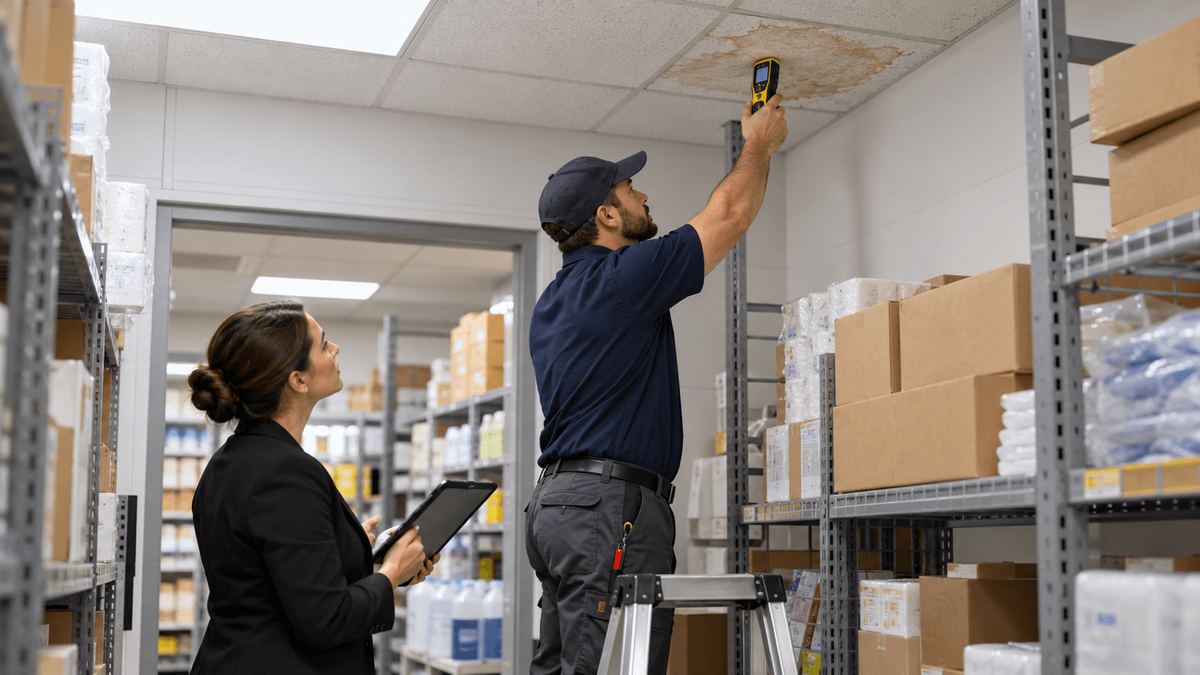
Retail roof leaks can affect merchandise, ceiling systems, customer areas, and hidden cavities, so a clear moisture response must start before the next storm.
A leak in a retail property rarely stays within one department. Store employees may move merchandise, maintenance may isolate the wet area, a landlord may call a roofer, and a restoration vendor may evaluate materials. If those actions are not connected, water can remain above ceilings, inside wall assemblies, or behind stocked shelving while each team believes someone else owns the follow-up.
Training helps property and store teams recognize moisture conditions, protect people and inventory, document the event, and coordinate qualified help. It does not turn every employee into a mold inspector or remediator. The goal is a reliable first response that addresses the water source, the affected building materials, and the handoff between store operations and property management.
Why Retail Moisture Events Need a Defined Response
Retail spaces combine public occupancy, changing inventory, complex leases, roof penetrations, plumbing, HVAC equipment, and extended operating hours. A stain may appear during business hours when the maintenance contact is off site. Staff may focus on the visible drip and miss wet insulation, wallboard, carpet backing, or cartons farther along the water path.
Roof leaks are not the only source. Condensation at diffusers, drain-line failures, restroom plumbing, sprinkler discharges, storefront leaks, refrigeration equipment, and water from adjacent tenants can all create damp materials. The correct response begins by identifying and stopping the source when it can be done safely, not by assuming every wet ceiling tile has the same cause.
Moisture can also create operational hazards before mold is visible. Wet floors can cause slips, saturated ceiling materials can fall, water may contact electrical components, and blocked aisles can affect egress. Employees should know how to isolate an area and request emergency help without touching energized equipment or disturbing questionable materials.
EPA guidance for commercial buildings emphasizes moisture control as the key to mold control. It also recommends addressing wet or damp materials promptly. Those principles are useful for planning, but the exact response depends on the material, extent, contamination, duration, building conditions, and state or local requirements.
A Retail Moisture Response Workflow
The first person who finds water should follow a simple notification and area-control procedure. Record the time, exact location, visible source if known, active dripping, affected merchandise or surfaces, odor, and immediate hazards. Use photos when permitted, but do not delay barricades, customer relocation, or emergency contact while trying to complete a perfect report.
Management should identify who has authority to close an aisle, move stock, shut down equipment, call property management, and request a vendor. Lease responsibilities should be reviewed before an incident, not debated under a leaking roof. Contact lists need coverage for nights, weekends, and severe weather when multiple properties may be affected at once.
The response team should trace the likely water path. Water can move along roof decks, joists, conduits, pipes, and ceiling grids before appearing. A dry floor beneath one stain does not prove the surrounding assembly is dry. Appropriate inspection tools and qualified personnel can help define the affected area without unnecessary demolition.
Inventory handling needs its own plan. Move unaffected merchandise away from the wet zone and document products that are damp, stained, or exposed to questionable water. Do not return products to sale merely because packaging looks dry on the outside. Follow company, insurer, supplier, and applicable health or product rules for evaluation and disposition.
Building materials should be evaluated by material type and condition. Clean, nonporous surfaces respond differently from porous ceiling tile, insulation, carpet, wallboard, paper products, and upholstered displays. Drying equipment must be selected and placed with consideration for electrical safety, occupant exposure, airflow paths, and any contamination concerns.
The source repair and material drying should be tracked as separate but connected tasks. A roof patch does not prove that the ceiling cavity is dry. Removing a stained tile does not prove that the roof leak is fixed. Closeout should include evidence that the source was corrected, affected materials were evaluated, drying or removal was completed, and the area was checked before normal use resumes.
Common Mistakes and Misconceptions
One misconception is that visible mold must appear before a moisture event matters. Waiting for discoloration or odor can allow damage to spread. A moisture response should begin when water intrusion or damp materials are discovered.
Another mistake is painting over a stain or replacing a ceiling tile without correcting the source. Cosmetic work can hide the history while moisture continues above the finish. The repair record should connect the observed damage to the source investigation and follow-up verification.
Teams also make mistakes when they use a moisture meter without understanding the instrument or material. Readings are affected by material type, depth, temperature, salts, metal, and meter design. Training should cover comparative measurements, limitations, and when a qualified assessment is needed. A single number is not a universal federal mold threshold.
Do not assume that running fans is always the right first action. Air movement may be inappropriate when water is contaminated, visible mold is present, dust could be dispersed, or affected cavities have not been evaluated. The response lead should consider the source and condition before directing airflow through occupied areas.
Another misconception is that a certificate makes someone licensed to inspect or remediate mold. Training can document course completion and support knowledge, but licensing, certification, and work-practice requirements vary by state and locality. Employers and individuals should check the rules where the property and work are located.
How Training Helps
Training gives store and property teams a shared vocabulary for moisture sources, material conditions, documentation, and escalation. Employees can practice distinguishing an immediate safety action from a technical assessment. Managers can rehearse vendor calls, lease notifications, inventory decisions, and after-hours coverage before a leak tests the process.
Maintenance personnel benefit from instruction on building-envelope clues, HVAC condensation, plumbing sources, moisture mapping, drying documentation, and limits of in-house work. Store employees need a shorter role-based version focused on recognizing water, isolating the area, protecting customers, and notifying the right people without disturbing materials.
The Mold Prevention Training course available through moldtraining.us is a natural fit for property managers, maintenance teams, and others who need foundational knowledge about moisture control and prevention. Employers should add site-specific procedures, lease responsibilities, emergency contacts, and hands-on instruction for the equipment their teams use.
Courses provide certificates of completion. They do not guarantee licensure, professional certification, employment eligibility, or authority to perform regulated work. Learners should review state and local requirements and obtain any additional credentials, supervision, or experience their jurisdiction requires.
A short drill can reveal practical gaps. Give the team a scenario involving a roof leak above a stockroom during business hours. Ask who closes the area, who moves inventory, who contacts the landlord, how the ceiling cavity is evaluated, where records are stored, and what evidence is required before closeout. Update the written response based on what the drill exposes.
Frequently Asked Questions
Should employees remove a stained ceiling tile immediately?
Not automatically. First address hazards such as falling material, electrical contact, and the occupied area. Tile removal can expose hidden contamination or release debris, so the decision should follow the property's procedure and an evaluation of the source and conditions.
Is a roof repair enough to close the moisture incident?
No. The repair may stop new water, but affected insulation, wallboard, ceiling tile, flooring, stock, or cavities still need evaluation. Closeout should address both the source and the condition of wet materials.
Does EPA set a federal safe level for indoor mold?
EPA does not establish a general federal mold threshold for buildings. Decisions should be based on moisture, visible growth, affected materials, occupant concerns, professional judgment, and applicable state or local rules rather than an invented universal number.
Can store staff use a moisture meter?
They can if the employer authorizes the task and provides instrument-specific training, but readings have limitations. Staff should know the material, reference method, meter mode, and escalation criteria. The tool supports an assessment; it does not independently determine whether mold is present.
When should a qualified professional be contacted?
Consider qualified help when the source is unclear, water may be contaminated, hidden or extensive growth is suspected, HVAC systems may be affected, occupants report health concerns, regulated materials may be disturbed, or the scope exceeds the team's training and equipment.
What records should the property retain?
Useful records include discovery time, source observations, photos, affected locations and materials, notifications, vendor reports, repairs, drying or removal actions, moisture checks, inventory decisions, occupant communications, and closeout approval. Retention should follow company, insurance, lease, and applicable legal requirements.
Conclusion
Retail moisture response works best when operations, maintenance, property management, and vendors share one process. The process should protect occupants, stop or control the source, evaluate affected materials, document decisions, and verify closeout instead of ending at the first cosmetic repair.
Training can make those handoffs faster and more consistent. A soft first step is to review the Mold Prevention Training course at moldtraining.us, then pair that foundation with the store's own contacts, lease terms, safety procedures, and state or local requirements.
Sources
EPA, Mold Remediation in Schools and Commercial Buildings: https://www.epa.gov/sites/default/files/2014-08/documents/moldremediation.pdf
EPA, Moisture Control for Buildings: https://www.epa.gov/iaq-schools/moisture-control-part-indoor-air-quality-design-tools-schools
EPA, Mold Remediation Guide Chapter 5: https://www.epa.gov/mold/mold-remediation-schools-and-commercial-buildings-guide-chapter-5