
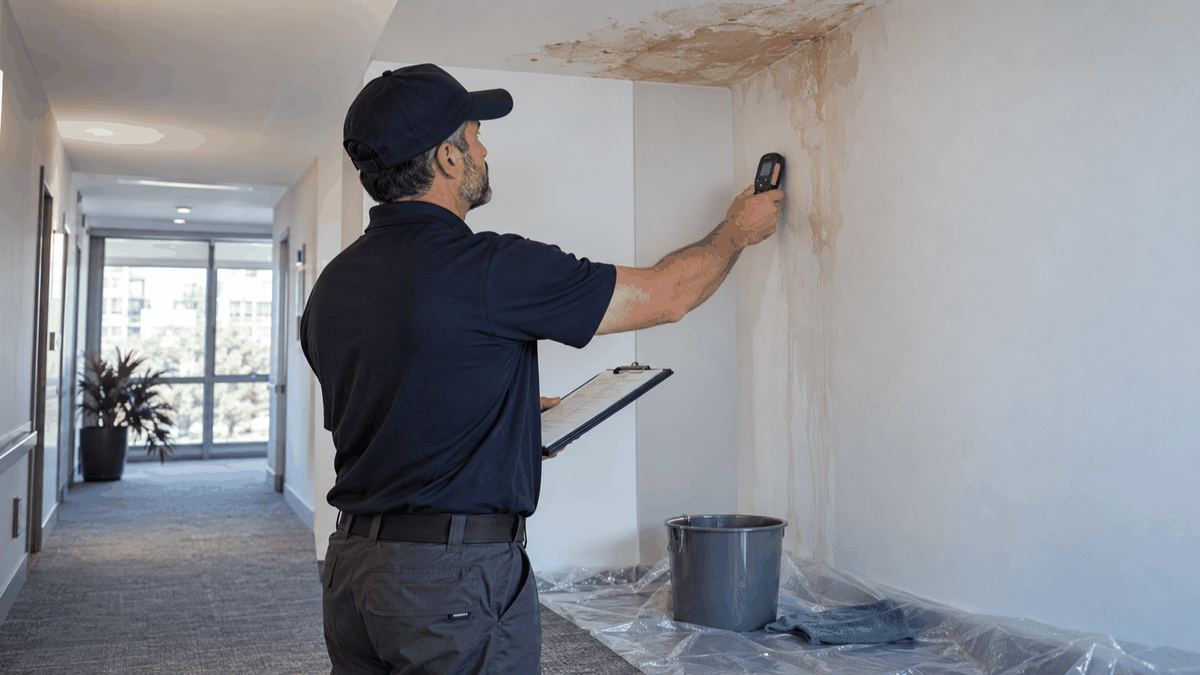
After a roof leak, property teams need a clear record for moisture, occupant protection, repairs, and decisions about specialized evaluation and follow-up.
A roof leak can create a chain of decisions that extends well beyond placing a bucket under a ceiling stain. Water may travel through insulation, wall cavities, flooring, or mechanical spaces before the visible mark appears. If a team documents only the stain and not the source, extent, timing, materials, and drying response, the next contractor may have to start the investigation over. Good documentation supports practical moisture control and clearer handoffs.
This article is educational information for property managers, maintenance staff, and facilities teams. It does not set a federal mold threshold, diagnose a health condition, replace a qualified inspection, or determine state or local legal requirements.
Why Roof Leaks Need a Documentation Routine
Moisture conditions change with weather, building use, and repair timing. A ceiling can look dry while insulation or a concealed cavity remains damp. A roof repair can stop new water while old moisture continues to affect materials. Heating, cooling, and ventilation can also move moisture through a building. A simple record helps the team distinguish the original event from later observations.
EPA guidance emphasizes moisture control and prompt attention to leaks and visible moisture. It also states that no federal limits have been set for mold or mold spores, so a property team should avoid turning one sample result into a universal pass or fail. The practical response begins with finding and controlling moisture, protecting people, and using qualified help when the situation exceeds the team's capability.
Common Mistakes and Misconceptions
A common mistake is painting over a stain before documenting it. The appearance may be hidden, but the source and affected materials still need attention. Another is assuming that a dry surface proves the assembly is dry. Measurements, material knowledge, and professional judgment may be needed to determine whether moisture remains.
Some teams treat every dark mark as proof of a specific mold type. Appearance alone cannot identify species, exposure, or a health outcome. Other teams assume that no visible growth means there is no moisture problem. Both conclusions can cause the response to focus on labels instead of the building condition.
There is also a misconception that an online course or certificate makes someone licensed for every mold service. Training can build awareness and support consistent procedures, but it does not guarantee licensure. Property teams should check state and local requirements and use qualified professionals for work that requires specialized evaluation, remediation, or regulated services.
FAQ: What Should We Photograph First?
Photograph the affected room or area, then the ceiling, wall, floor, equipment, and any visible water path. Include a scale or familiar reference when useful, but do not include private information in a shared record. Record the date, approximate time, weather, room or asset identifier, and whether the area was occupied. Photos should show context as well as close detail.
FAQ: Should the Team Sample Immediately?
Not every visible moisture event requires immediate sampling. EPA notes that sampling may be unnecessary when visible mold is present and that sampling cannot be used to check compliance with federal mold standards. The decision should match the question the property owner needs answered, the building condition, and the qualifications of the person designing and interpreting the sampling.
FAQ: What Belongs in a Moisture Log?
Record the suspected source, first report, affected materials, visible condition, meter type and readings if used, indoor conditions, actions taken, people notified, contractor visits, drying equipment, and follow-up dates. Keep readings tied to a location and material. A single number without context is difficult to interpret later.
FAQ: When Should We Escalate?
Escalate when the source is not controlled, moisture is widespread or concealed, building materials may require specialized handling, occupants report concerns that need professional evaluation, sewage or contaminated water is involved, or the team lacks the equipment and training to work safely. Escalation is also appropriate when the same area repeatedly becomes damp.
FAQ: How Long Should Records Be Kept?
Keep records according to the property owner's document-retention policy, insurance needs, contract requirements, and applicable state or local rules. Preserve the initial report, photos, work orders, invoices, readings, clearance or completion documents if used, and communications that explain decisions. A consistent file is more useful than a large collection of unlabeled images.
What Property Teams Should Document
Begin with the event timeline. Note when the leak was discovered, the weather or roof condition, who reported it, whether water was active, and what temporary control was installed. If the roof was inspected, record the area inspected and any limitation, such as unsafe access or weather preventing a complete review. Do not state that the roof is fixed if only a temporary patch was made.
Map the interior impact. Identify rooms, floors, ceiling types, wall assemblies, insulation, furnishings, flooring, and nearby HVAC or electrical equipment. Mark whether each item is visibly wet, stained, damp by measurement, dry but suspected to have been affected, or not evaluated. This simple status language prevents “affected” from being used as a vague substitute for observation.
Document moisture-control actions. Note when water was extracted, wet materials were moved or protected, fans or dehumidifiers were placed, filters were changed if appropriate, and the area was checked again. Record who performed the action and what remained inaccessible. If equipment is used, log location and operating period rather than assuming it reached every affected material.
Keep the repair and inspection handoff connected. The roof contractor may document the exterior source, while a building professional may evaluate interior materials. Share the room map, photos, timeline, and known limitations through the approved process. Ask for written descriptions of what was inspected, what was repaired, what was not evaluated, and what follow-up is recommended.
How Training Helps
Mold prevention training helps property teams recognize the relationship between moisture, building materials, occupant communication, and maintenance decisions. In a roof-leak exercise, staff can practice documenting the first report, protecting the area, identifying vulnerable materials, requesting the right help, and setting a follow-up date. The value is consistency: different shifts should create records that the next person can understand.
The moldtraining.us Property Management Mold Training course can be a natural fit for teams that manage tenant spaces, maintenance requests, and vendor coordination. Courses provide certificates of completion, but they do not guarantee licensure or replace state and local requirements. Employers should confirm whether a particular task requires additional credentials, supervision, or a qualified specialist.
Training should include communication boundaries. Staff can explain what was observed, what action was taken, and what is still being evaluated without promising that a building is safe, claiming a federal certification, or offering medical conclusions. A clear script can direct occupant questions to the appropriate property, health, or professional channel while the moisture response continues.
A Practical Before-and-After Workflow
Before repairs, secure the immediate area, protect occupants from slip or electrical hazards, stop or contain the water when it can be done safely, and document the condition. Identify the owner of the roof response and the owner of the interior response. Establish when the area will be checked again and what event would require escalation.
During repairs, keep the timeline current. If the source changes, if new areas become damp, or if materials are opened, add the observation and the responsible party. Avoid destroying evidence through premature cleanup or disposal when an insurer, owner, or qualified evaluator needs to understand the event. Follow the property's approved procedures for damaged materials and waste.
After repairs, verify the source was addressed and review the affected areas for remaining moisture, odor, staining, or recurring dampness. Close the work order only when the record explains what was checked and what remains outside the team's scope. A follow-up inspection can be more informative than a single end-of-job statement.
Brief Conclusion
Roof-leak response is stronger when property teams document moisture and decisions before the visible evidence disappears. Use a consistent timeline, area map, photo set, moisture log, vendor handoff, and follow-up plan. Training can help staff perform those steps within their role, while qualified professionals and local requirements guide specialized work.
Sources U.S. EPA, Mold Testing or Sampling, https://www.epa.gov/mold/mold-testing-or-sampling; U.S. EPA, Biological Contaminants and Indoor Air Quality, https://www.epa.gov/indoor-air-quality-iaq/biological-contaminants-and-indoor-air-quality; U.S. EPA, Moisture Control Guidance for Building Design, Construction and Maintenance, https://nepis.epa.gov/Exe/ZyPURL.cgi?Dockey=P100HF07.TXT