
Childcare teams need a moisture-response routine that protects occupied rooms, records facts clearly, and moves repairs forward without alarming families.
Early-learning facilities contain sinks, child-height toilets, bottle-preparation areas, kitchens, roof penetrations, HVAC equipment, floor drains, exterior doors, and frequent cleaning activity. A small leak can affect a classroom schedule, stored materials, furnishings, and communication with families long before the source is fully understood. Because young children use floors and low surfaces closely, teams often feel pressure to give immediate answers.
A calm process begins with moisture control, not a quick conclusion about mold. Staff should recognize warning signs, protect children from unsafe conditions, report observations accurately, and escalate work within their roles. Facility managers and qualified professionals can then evaluate the source, affected materials, drying, cleaning, and any need for specialized work.
Why Childcare Moisture Events Need a Specific Plan
Childcare operations cannot always close a room without affecting ratios, supervision, meals, naps, pickup, or special services. That operational pressure can lead teams to minimize a damp cabinet, move children without documenting the original condition, or reopen an area before the repair and material response are complete. A written plan makes the decision less dependent on the busiest person in the building.
The plan should cover classrooms, restrooms, kitchens, storage rooms, laundry areas, mechanical spaces, basements, crawl spaces, and outdoor drainage near the building. It should also address portable classrooms or leased suites where the operator and property owner divide responsibilities. The first report needs to reach both the person who controls the room and the person who can authorize building work.
EPA guidance for schools and commercial buildings emphasizes moisture control as the key to mold prevention. It does not create a universal federal mold threshold for every indoor space. Visible growth, musty odors, recurring condensation, and wet materials are reasons to investigate and respond, but building staff should avoid making medical claims or declaring a space safe based on one observation.
Communication matters because families may hear a partial description from a child or staff member. Factual updates can explain what was observed, what area was restricted, what source-control or evaluation steps are underway, and when another update will be provided. Staff should not speculate about health effects, identify a substance without support, or promise that a repair prevents all future problems.
Building a First-Response Routine
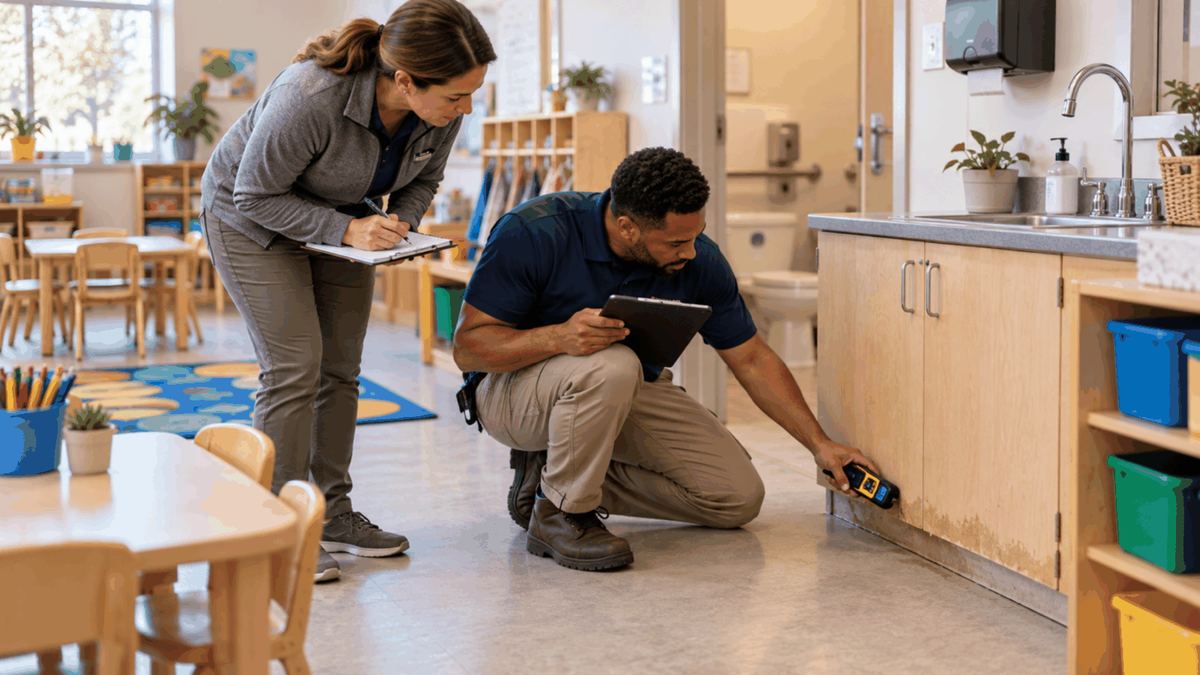
The first person who notices moisture should record the date, time, exact location, source if visible, active water, odor, discoloration, damaged materials, and immediate hazards. Useful language is specific: water is dripping below the sink supply connection, the cabinet base is damp, or ceiling tile above the reading corner is stained. Labels such as toxic mold or harmless condensation are conclusions the observer may not be qualified to make.
Protect occupants first. Keep children and unnecessary staff away from active leaks, slippery floors, damaged ceilings, electrical hazards, contaminated water, or maintenance work. Use the facility's supervision and room-relocation procedures so that access control does not create a staffing or security problem. If water may involve sewage, flooding, chemicals, or another contaminated source, escalate promptly rather than treating it as an ordinary clean-water spill.
Stop the moisture source when staff can do so safely and within their authority. That may mean shutting a fixture valve, taking a sink out of service, calling building maintenance, or contacting the property owner. Record who was notified and when. A work order that says only check leak does not preserve enough information for later review.
Document the likely affected area without disturbing materials unnecessarily. Check adjacent cabinets, baseboards, flooring edges, the opposite side of the wall, and the room below when appropriate. Moisture meters can support the evaluation when used by trained people who understand the instrument, material, comparison area, and limitations. A number alone is not a universal mold test or a pass-fail result.
Separate the work into stages. Source repair, water removal, material evaluation, drying, cleaning, restoration, and final review may involve different people. Closing the plumbing work order should not automatically close the moisture event if porous materials, concealed spaces, or adjacent rooms still need attention.
Plan communication at each stage. Classroom staff need to know access limits and schedule changes. Administrators need the building status and documentation. Families may need a concise operational update, especially if a room moves or belongings are affected. Vendors need a defined scope, site rules, work hours, and contact. One coordinator should prevent inconsistent messages.
Common Mistakes and Misconceptions
One mistake is assuming that a strong odor proves mold or that no odor proves the room is clear. Odor is useful information, but it does not identify the source, extent, or material. Combine it with moisture history, visual inspection, and qualified evaluation when needed.
Another misconception is that wiping a surface with bleach completes the response. Cleaning does not repair a leaking valve, failed roof flashing, condensation pattern, damaged seal, or wet wall cavity. Product use must also follow label directions, facility policies, ventilation needs, and child-access precautions.
Teams sometimes put a fan in the room immediately without considering the water source, contamination, electrical safety, airflow path, noise, or whether moving air could spread particles. Drying equipment should be selected and placed for the event, then documented and monitored.
A common documentation error is photographing children, names, medication information, or personal records while trying to capture the damaged area. Follow privacy rules, frame only what is needed, and store images in the approved system. Explain the purpose of photographs when appropriate.
Another mistake is reopening a room because the visible surface feels dry. Moisture may remain in cabinet bases, wallboard, insulation, flooring layers, or concealed cavities. Final review should address the repaired source, affected materials, drying or removal decisions, cleaning, and any follow-up inspection.
Finally, a course certificate should not be described as a mold license or government certification. Requirements for assessment, remediation, contracting, disclosure, and licensing differ by state and locality. Facilities and individuals should check the rules that apply where work will be performed.
How Training Helps
Training gives administrators, teachers, custodians, maintenance staff, and vendors a shared vocabulary and escalation process. Teachers can learn what to report and how to keep children away from a condition. Custodial staff can distinguish ordinary spill cleanup from events that need maintenance or management review. Maintenance staff can practice source control, documentation, material decisions, and closure. Administrators can coordinate occupancy, family communication, vendor access, and records.
The Mold Awareness, Prevention and Remediation Training for Property Management Teams at moldtraining.us is a natural fit for facility managers and maintenance personnel who coordinate moisture reports, work orders, occupants, and vendors. Staff with narrower awareness duties may consider the Mold Prevention and Remediation Awareness course. Specialized inspection or remediation work may require deeper training, experience, and any credentials required by the jurisdiction.
The courses provide certificates of completion. They do not guarantee licensure, authorize regulated work, or guarantee acceptance by an employer or agency. Learners and facilities should review state and local requirements, match training to assigned duties, and provide building-specific instruction.
A useful exercise starts with water beneath a classroom sink fifteen minutes before children arrive. Add a damp cabinet back, a neighboring restroom wall, art supplies stored on the floor, a parent question, and a vendor who cannot arrive until afternoon. Ask each role what to document, who can shut the fixture, where the class moves, what information is shared, and what evidence is needed before reopening.
Training should also include recurrence review. If the same sink, roof area, exterior wall, or HVAC drain appears in several work orders, the team should link the records and investigate the pattern. Prevention improves when teams move beyond isolated tickets and address repeat causes.
Frequently Asked Questions
Does a wet cabinet mean mold is present?
No. Wet material creates conditions that may support growth, but moisture alone does not establish that mold is present. Stop the source, document and evaluate the affected area, dry or remove materials as appropriate, and obtain qualified help when the condition exceeds routine staff capability.
Should the classroom close after every leak?
Not every leak requires the same response. The decision depends on the source, active hazards, affected area, materials, work required, ability to restrict access, supervision, facility procedures, and advice from appropriate professionals. A predefined decision process helps administrators act consistently.
Can staff test the air to prove the room is safe?
Routine air sampling is not a universal pass-fail method for mold. Results require context and may not answer the moisture question. Begin with source investigation, visual and material assessment, moisture control, and applicable professional guidance.
How quickly should wet materials be addressed?
They should be addressed promptly. The practical response depends on the water source, material, extent, temperature, humidity, and access. Do not use a single clock as a guarantee that growth will or will not occur. Record the discovery time and the actions taken.
Does a moldtraining.us certificate make someone a licensed mold professional?
No. The courses issue certificates of completion and do not guarantee licensure or authorization to perform regulated work. Learners and employers should check current state and local requirements for their location and duties.
Next Step
Review the last five water, plumbing, roof, HVAC, or condensation work orders from the facility. Check whether each one identifies the source, affected rooms and materials, child-access controls, notifications, repair, drying or removal decision, final review, and follow-up owner. Where the chain breaks, update the form and assign responsibility.
Then walk one classroom, restroom, and mechanical area with the administrator and maintenance lead. Confirm shutoff access, emergency contacts, photo and privacy rules, room-relocation options, vendor procedures, and the place where moisture records are stored. A short drill can reveal gaps before a real event disrupts the day.
For teams that need a common foundation, consider the relevant moldtraining.us awareness or property-management course as part of onboarding or refresher training. Pair online learning with facility-specific procedures and hands-on instruction for any instruments or equipment staff are expected to use.
Conclusion
Childcare moisture response depends on fast reporting, careful access control, factual communication, source repair, appropriate material decisions, and documented closure. A shared routine helps the facility protect occupied spaces without making unsupported claims. Training strengthens that routine, while qualified evaluation and state or local requirements determine when specialized services are needed.
Sources
U.S. EPA, Mold Course Introduction | https://www.epa.gov/mold/mold-course-introduction
U.S. EPA, Mold Remediation in Schools and Commercial Buildings Guide | https://www.epa.gov/mold/mold-remediation-schools-and-commercial-buildings-guide
U.S. EPA, Moisture Control Guidance for Building Design, Construction and Maintenance | https://www.epa.gov/indoor-air-quality-iaq/moisture-control-guidance-building-design-construction-and-maintenance
U.S. EPA, Healthy Child Care and Early Learning Facilities Self-Assessment | https://www.epa.gov/schools/healthy-child-care-early-learning-facilities-self-assessment
CDC, Mold | https://www.cdc.gov/mold-health/about/index.html