
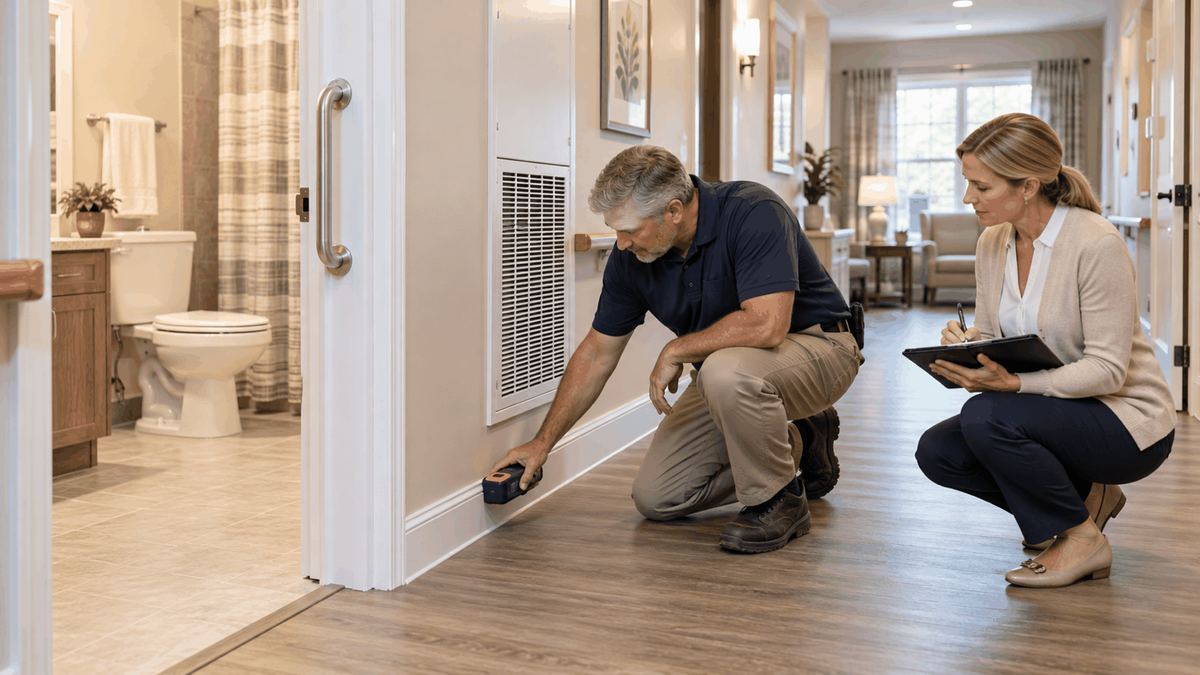
Senior living teams need a calm moisture-response routine that protects residents, documents building conditions, and moves repairs forward without delay.
Senior living facilities combine apartments or rooms, shared bathrooms, dining areas, laundry operations, mechanical systems, housekeeping, maintenance, and frequent communication with residents and families. That mix creates many ordinary sources of moisture and many handoffs between the people who first notice a problem and the people who can correct it. A slow plumbing leak, wet baseboard, condensation near an exterior wall, blocked fan, or damp ceiling tile can cross several shifts before anyone sees the complete pattern.
A practical mold-prevention program focuses first on moisture. Staff do not need to diagnose mold during every service call. They do need to recognize signs of water intrusion, respond within their roles, protect occupants from unsafe conditions, document observations accurately, and escalate work when the scope or health concerns exceed routine maintenance. Training gives those roles a shared process without turning general staff into inspectors or remediators.
Who This Affects
Property managers, executive directors, facility managers, maintenance technicians, housekeepers, environmental services staff, leasing or admissions teams, resident-services staff, security, and outside vendors can all encounter moisture information. Clinical personnel may also hear a resident concern first, although building assessment and medical evaluation remain different responsibilities.
The process should respect residents' privacy, schedules, mobility, and right to understand what work is happening in their space. A maintenance response that works in an empty office may not fit an occupied unit where a resident uses mobility equipment, receives care, keeps personal property near the repair, or needs an alternate room while materials are opened or dried.
Moisture Risks Across Senior Living Facilities
Resident rooms and apartments can have bathroom humidity, supply-line leaks, toilet overflows, appliance connections, window condensation, exterior-wall intrusion, HVAC condensate problems, and spills that reach carpet or baseboards. Common spaces add commercial kitchens, group bathrooms, indoor plants, housekeeping closets, fitness or therapy areas, and large roof or exterior-wall areas. Laundry rooms create heat, humidity, drain, and hose concerns in one location.
Moisture can also travel beyond the point where it becomes visible. Water from an upper-floor bathroom may appear at a ceiling joint below. A slow leak inside a vanity may wet the cabinet back and wall cavity before flooring changes color. Condensation may collect behind furniture placed against a cool exterior wall. The first wet spot is therefore a starting point for evaluation, not necessarily the full boundary.
EPA guidance emphasizes moisture control as central to mold prevention. EPA does not establish a single federal mold threshold that decides whether every building condition is acceptable. Visible growth, musty odors, wet materials, and recurring moisture are reasons to investigate the source and determine an appropriate response based on the situation.
Health questions require careful communication. Staff should not diagnose symptoms, declare a room medically safe, or promise that a repair will eliminate a health problem. The facility can document building conditions and work performed while residents seek advice from qualified healthcare professionals.
What Property Teams Should Check
Make the first report useful
The first record should identify the exact location, date and time, who reported the issue, what was observed, whether active water is present, whether electrical or slip hazards exist, and whether an occupied area needs immediate protection. Use factual language such as damp drywall below the window or water visible at the toilet supply connection. Avoid conclusions such as toxic mold or harmless condensation unless a qualified evaluation supports them.
Photos can help show location and extent, but the facility should follow privacy rules and avoid capturing residents, medical information, personal documents, or unrelated belongings. Staff should explain why photos are being taken and store them in the approved maintenance or incident system.
Control the source and protect the area
Stop or isolate water when this can be done safely and within staff authority. Use barriers for slip or electrical hazards, move vulnerable property with permission, and coordinate an alternate space when conditions interfere with normal use. If the water may be contaminated, the event involves sewage or flooding, or materials require specialized removal, escalate to appropriate qualified help rather than treating the event as a routine clean-water leak.
Ventilation and drying equipment should be selected for the building and event. Placing a fan without considering contamination, electrical safety, occupant comfort, noise, doors, pressure relationships, or where air is moving can create other problems. Equipment settings, locations, and operating periods should be documented and reviewed.
Define and track the affected area
Inspect nearby finishes and adjacent spaces logically. That may include the opposite side of a wall, the floor below, the cabinet interior, baseboards, flooring edges, pipe chases, and HVAC components. Moisture-meter readings can support decisions when staff are trained to use the instrument and understand its limitations. A number without material type, comparison area, location, date, and instrument context may be difficult to interpret later.
The work order should separate source repair, material response, drying checks, restoration, and final review. Closing the plumbing ticket should not automatically close the moisture event if wall, ceiling, cabinet, or floor materials still need evaluation. Assign owners and due dates for each step.
Watch for recurrence
A second leak at the same location is not simply another isolated ticket. Trend reports can reveal repeated bathroom overflows, condensation at similar exterior rooms, roof leaks during wind-driven rain, or drain problems tied to one stack. Property teams should review recurrence by asset, room type, building wing, weather, and cause so preventive maintenance can target patterns.
After repairs, communicate the result in plain language. Record what source was corrected, which materials were inspected or removed, how drying was checked, whether follow-up is planned, and whom the resident should contact if moisture returns. Do not make guarantees about future mold or health outcomes.
Common Mistakes and Misconceptions
One misconception is that a musty odor without visible growth can be ignored. Odor can justify checking for hidden moisture even though it does not identify the source by itself. The opposite mistake is calling every stain mold. Discoloration can have several causes, and unqualified labels can create confusion and fear.
Another mistake is using bleach or another product as the entire response. Cleaning does not correct a leaking pipe, condensation pattern, failed sealant, roof defect, or wet wall cavity. Product selection also depends on the material, condition, occupant considerations, and work practices. Staff should follow the facility's procedures and product safety information.
Facilities sometimes close a ticket after surfaces feel dry to the touch. Porous materials or concealed layers can remain wet. A consistent verification step, performed by someone trained for the task, provides stronger support than appearance alone.
It is also a mistake to promise that a course, certificate, or vendor designation guarantees licensure or regulatory acceptance. Mold requirements differ by state and locality. Facilities and individuals should review current state and local rules for assessment, remediation, contracting, disclosure, and licensing before offering regulated services or assigning specialized work.
How Training Helps
Training helps staff distinguish awareness, maintenance response, professional inspection, and remediation roles. Housekeeping and resident-services teams can learn what to report and how to protect the location. Maintenance teams can practice source control, documentation, escalation, and verification. Managers can build work-order fields, vendor scopes, resident communication, and review routines that connect the entire response.
The Mold Awareness, Prevention and Remediation Training for Property Management Teams at moldtraining.us is the most natural fit for managers, maintenance staff, and other property personnel who handle moisture reports and documentation. General employees with narrower duties may benefit from the Mold Prevention and Remediation Awareness course. Professional inspection work may require deeper education and any credentials required by the jurisdiction.
The courses provide certificates of completion. They do not guarantee licensure, authorization to perform regulated work, or a particular employer or agency decision. Learners and employers should check state and local requirements and match training to actual job duties.
A useful training exercise follows one event from the first call through closure. Give the team a bathroom leak in an occupied room, then add an inaccessible wall cavity, a resident concern, a wet ceiling below, and a vendor handoff. Ask each participant what they document, whom they notify, what they are authorized to do, and what evidence is needed before closure.
Frequently Asked Questions
Does a moisture report mean the facility has mold?
No. Moisture creates conditions that may support growth, but a report of water or dampness does not by itself establish that mold is present. The facility should address the source promptly, inspect the affected area, document conditions, and obtain qualified help when the situation exceeds routine staff capabilities.
Should staff use a moisture meter in every resident room?
Not automatically. A meter can support an investigation when the user is trained, the instrument fits the material, and readings are documented with useful context. It should not be used as a universal pass or fail device or as a substitute for source investigation and visual inspection.
Can residents remain in the room during drying or repair?
That decision depends on the source, affected materials, work methods, equipment, noise, access, resident needs, and facility procedures. Managers should coordinate with appropriate building, safety, clinical, and remediation professionals rather than applying one rule to every event.
Is there a federal mold level that makes a room safe or unsafe?
EPA does not provide a single federal mold threshold for all indoor environments. Decisions should focus on moisture, visible or suspected growth, affected materials, occupant concerns, applicable guidance, and state or local requirements.
Does a moldtraining.us certificate make someone a licensed mold professional?
No. The courses issue certificates of completion and do not guarantee licensure. Licensing and practice requirements vary, so learners and employers should check the state and local rules that apply where work will be performed.
Next Step
Review the last five moisture-related work orders from resident rooms and common areas. Check whether each record identifies the source, affected locations, resident communication, immediate controls, repair, drying or material decision, final verification, and follow-up owner. Where the chain breaks, update the form and assign responsibility.
For teams that need a common foundation, consider the property-management course at moldtraining.us as part of onboarding or refresher training. Pair it with building-specific procedures, privacy expectations, vendor contacts, emergency rules, and hands-on instruction for any instruments staff are expected to use.
Conclusion
Mold prevention in senior living facilities is built on reliable moisture response. A respectful first contact, factual documentation, prompt source control, clear handoffs, verification, and recurrence review help property teams act consistently across resident rooms and shared spaces. Training supports that process, while qualified evaluation and state or local requirements determine when specialized services are needed.
Sources
U.S. EPA, Mold Course Introduction | https://www.epa.gov/mold/mold-course-introduction
U.S. EPA, Mold Remediation in Schools and Commercial Buildings Guide | https://www.epa.gov/mold/mold-remediation-schools-and-commercial-buildings-guide
U.S. EPA, Moisture Control Guidance for Building Design, Construction and Maintenance | https://www.epa.gov/indoor-air-quality-iaq/moisture-control-guidance-building-design-construction-and-maintenance
U.S. EPA, Biological Contaminants and Indoor Air Quality | https://www.epa.gov/indoor-air-quality-iaq/biological-contaminants-and-indoor-air-quality
CDC, Mold | https://www.cdc.gov/mold-health/about/index.html