
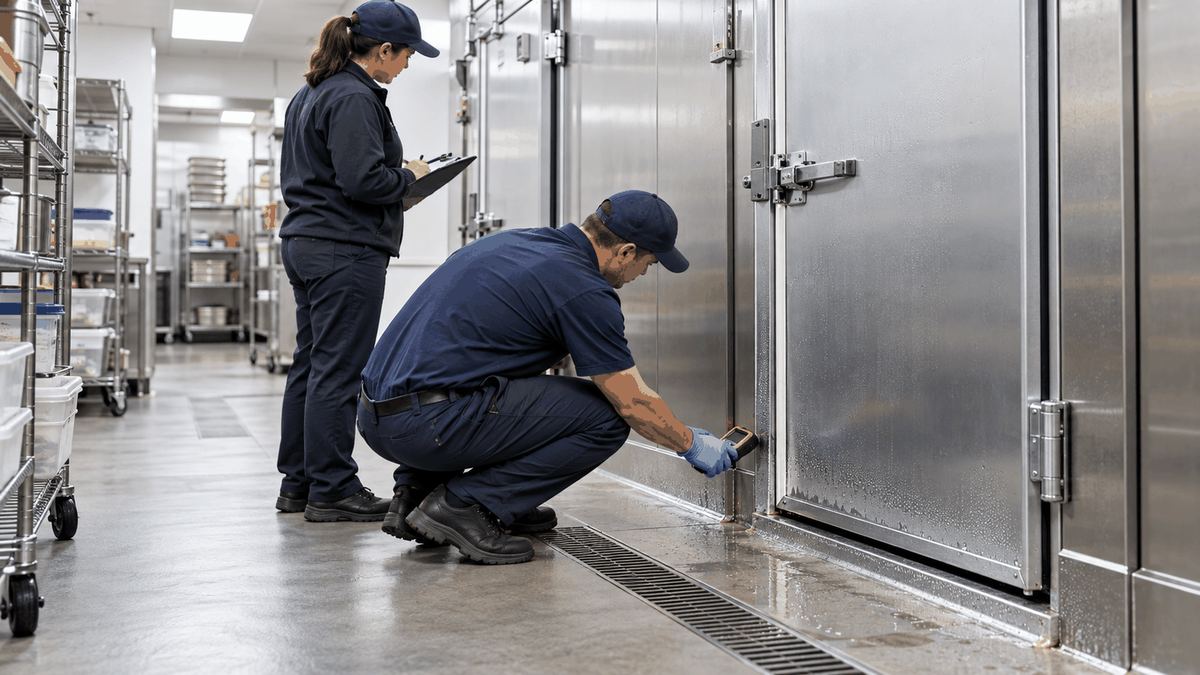
Walk-in coolers can hide condensation and leakage around doors, panels, drains, and nearby finishes, making moisture checks essential for property teams.
Cold storage areas create a simple physical challenge with complicated building consequences: warm, moisture-bearing air repeatedly meets cold surfaces. That interaction can produce condensation on door frames, piping, ceilings, panel joints, floors, and adjacent walls. Equipment drains can clog or leak, door gaskets can fail, and damaged insulation can leave surfaces colder than intended. When moisture reaches porous building materials or hidden cavities, a maintenance issue can become a broader indoor moisture concern.
Property managers and maintenance teams do not need to diagnose every condition during a routine round. They do need a repeatable way to notice moisture, document its location and extent, protect occupants and workers, route the issue to qualified help, and verify that repairs corrected the source. Mold prevention training can provide that shared workflow without suggesting that a certificate of completion is a professional license.
Why Cold Storage Areas Need a Focused Moisture Routine
Walk-in coolers and freezers operate across a strong temperature difference. Every door opening admits warmer air. If the door does not close fully, the gasket is damaged, or traffic holds the opening for long periods, moisture can collect as frost or liquid water. Condensation may also appear outside the enclosure when nearby air contacts cold framing, fasteners, pipes, or inadequately insulated surfaces.
Moisture is not always visible at eye level. Water can travel beneath floor finishes, behind base materials, through panel seams, or into a wall shared with a kitchen, storage room, or corridor. Staff may first notice staining, swelling, peeling finishes, persistent odor, loose flooring, corrosion, or repeated service calls. Training should help teams treat those observations as information about moisture movement rather than isolated cosmetic defects.
EPA guidance emphasizes moisture control as the key to mold prevention. It advises prompt attention to leaks, wet materials, humidity, condensation, HVAC drainage, and recurring inspection. Those principles apply to cold storage surroundings, but the repair details can require refrigeration, building-envelope, plumbing, electrical, or industrial-hygiene expertise. A property team's role is to recognize, document, escalate, and confirm follow-through within its training and authority.
What Property Teams Should Check
Begin outside the unit. Look at the door perimeter, hinges, latch, threshold, sweep, and gasket. Note gaps, tears, compression loss, ice, sweating, or water marks. Observe whether the door closes by itself as intended or is routinely propped open. A photograph taken from the same position during recurring inspections can make slow changes easier to recognize.
Check adjacent walls and ceilings for staining, bubbling paint, softened gypsum board, loose wall covering, corrosion, or condensation. Pay attention to penetrations for refrigerant lines, conduit, sprinklers, and controls. A cold penetration can create a condensation point, while an incomplete seal can allow moist air into a cavity. Do not open energized equipment or disturb suspect materials beyond the team's authorized procedures.
Inspect the floor transition and nearby drains. Look for ponding, damaged grout or seams, lifted flooring, darkened base materials, and a path showing where water travels during cleaning or defrost. Confirm that drains are accessible and appear to flow, but avoid adding chemicals or dismantling components unless the procedure and manufacturer guidance allow it.
Inside the unit, observe panel joints, ceiling surfaces, shelving contact points, evaporator areas, and drain components that are safely visible. Record recurring frost, drips, standing water, blocked airflow, damaged panels, or wet stored materials. Food-safety, sanitation, and refrigeration procedures may control who can enter, move stock, or service equipment, so coordinate the moisture check with the responsible operation.
Building a Practical Response Workflow
The first step is controlling active water when it can be done safely. That might mean placing the area out of service, protecting nearby materials, correcting a door that was left open, or calling refrigeration or plumbing support. Staff should not make an improvised repair that hides the condition, disrupts equipment, or creates an electrical or food-safety risk.
Create a record that distinguishes observation from conclusion. Write what was seen, smelled, felt, or measured: water at the lower right door frame, wet baseboard six feet along the corridor wall, frost at a panel seam, or a drain pan overflowing. Avoid labeling an unknown stain as a specific mold or declaring the source confirmed without supporting evaluation.
Assign the issue based on likely system responsibility. Refrigeration contractors may address equipment, insulation, heaters, gaskets, or defrost drainage. Plumbers may address supply or waste piping. Building-envelope or flooring specialists may evaluate assemblies. A qualified mold assessor or remediation professional may be appropriate depending on the extent, occupancy, jurisdiction, and company policy.
Plan for drying and material decisions. EPA and CDC resources emphasize prompt drying of wetted materials and correction of the moisture source. Porous materials that remain wet or are visibly affected may need professional evaluation and removal. Painting over staining or closing a wall before moisture conditions are resolved can conceal the problem and complicate later work.
Verify the repair under realistic operating conditions. A gasket replacement may look complete while the door is open but fail after temperature recovery and normal traffic. A drain may flow during a test but back up during defrost. A wall may feel dry at the surface while moisture remains beneath a finish. Follow-up should match the suspected mechanism and include a scheduled recheck.
Closeout records should identify the source if confirmed, repairs performed, materials dried or removed, contractors involved, dates, and follow-up findings. If the cause remains uncertain, keep the issue open with a defined next action. A closed ticket should mean the moisture pathway and affected materials were addressed, not merely that someone visited the site.
Common Mistakes and Misconceptions
If the cooler holds temperature, there cannot be a moisture problem
Temperature performance and moisture control are related but not identical. A unit may maintain its setpoint while a door frame sweats, a drain leaks, or an adjacent wall accumulates condensation. Maintenance rounds should look beyond the temperature display.
Condensation is normal, so it does not need documentation
Some condensation can occur during operating cycles or door openings, but recurring water on building finishes deserves attention. Documentation helps teams identify frequency, location, and change over time. The question is not whether condensation can occur; it is whether moisture is being controlled without damaging materials.
A dry surface means the assembly is dry
Surface conditions can improve before water beneath flooring, inside insulation, or behind a wall has dried. Screening tools and follow-up observations have limits. When hidden moisture is plausible, teams should route the issue for appropriate evaluation rather than relying on touch alone.
Any dark mark should be sampled first
EPA and CDC guidance does not establish routine sampling as the first step for every visible condition. Moisture correction and appropriate cleanup are central. Sampling decisions depend on the situation and may require a qualified professional, especially where regulations, health concerns, litigation, or complex building conditions are involved.
Bleach or paint solves the source
Applying a product to a surface does not repair a leaking drain, failed gasket, missing insulation, or uncontrolled humidity. Cleaning and material treatment must be paired with source correction, safe work practices, and drying. Painting over damp or affected material can hide evidence without resolving the condition.
One national rule covers every mold service
There is no single federal mold licensing framework that answers every state or local requirement. Some jurisdictions regulate assessment, remediation, contracting, or related work. Property teams and course participants should check current state and local requirements before offering or performing regulated services.
How Training Helps
Training gives property teams a common vocabulary for moisture sources, condensation, material response, documentation, and escalation. That shared language improves handoffs between leasing staff, maintenance technicians, managers, vendors, and occupants. It also helps separate a field observation from a technical conclusion.
A relevant moldtraining.us mold prevention or mold awareness course can support employees who perform routine inspections and respond to moisture reports. The course can reinforce why moisture source correction matters, how to document without overclaiming, and when work should move to qualified specialists. Site-specific instruction should still cover the actual cooler equipment, food-safety rules, electrical hazards, emergency contacts, and company procedures.
Courses provide certificates of completion. A certificate documents course completion; it does not guarantee licensure, authorize work outside a person's qualifications, or replace state and local requirements. Employers should verify which rules apply to their location and scope of work.
Practice strengthens training. Teams can walk the area, trace likely moisture paths, write an objective service ticket, and decide what requires escalation.
Frequently Asked Questions
How often should a walk-in cooler area be checked for moisture?
Frequency should reflect equipment history, traffic, climate, operating procedures, manufacturer recommendations, and company policy. Daily operational observations may be paired with more detailed periodic checks and additional inspections after leaks, repairs, defrost problems, power loss, or persistent door issues.
Should property staff use moisture meters around a cooler?
Meters can support screening when staff are trained to use the instrument and interpret its limitations. Readings vary with materials and conditions. They should be documented as readings, not treated as a stand-alone diagnosis or proof that concealed areas are unaffected.
What should happen when staff find visible mold-like growth?
Protect people from unnecessary disturbance, document the location and extent, identify and control active moisture when safe, and follow the organization's escalation procedure. The appropriate assessor or remediation resource depends on scope, materials, occupancy, and state or local requirements.
Can a refrigeration contractor handle the entire response?
A refrigeration contractor may correct the equipment source, but affected building materials may require separate drying, assessment, repair, or remediation. Closeout should address both the cause and the materials exposed to moisture.
Do federal agencies certify mold inspectors or property teams?
Do not describe a course or worker as EPA-, OSHA-, or CDC-certified for mold work. Federal guidance provides useful moisture and mold information, but applicable credentialing and licensing requirements may come from states, local jurisdictions, employers, or specific contracts.
Conclusion
Walk-in coolers deserve a place in the property's moisture-control routine because their cold surfaces, doors, drains, and penetrations can create recurring conditions that reach beyond the equipment enclosure. Consistent checks help teams notice patterns before affected materials and service calls multiply.
The practical sequence is simple: observe carefully, document objectively, control active moisture safely, assign the right expertise, and verify the result under normal operation. Mold prevention training can make that sequence repeatable across shifts and properties while keeping decisions within each person's role and applicable requirements.
Sources
United States Environmental Protection Agency, Moisture Control Guidance for Building Design, Construction and Maintenance: https://www.epa.gov/indoor-air-quality-iaq/moisture-control-guidance-building-design-construction-and-maintenance-0
United States Environmental Protection Agency, Mold Course Chapter 9: https://www.epa.gov/mold/mold-course-chapter-9
Centers for Disease Control and Prevention, Mold: https://www.cdc.gov/mold-health/about/index.html
Centers for Disease Control and Prevention, Mold, Testing, and Remediation: https://www.cdc.gov/niosh/mold/testing-remediation/index.html