
Fitness centers create recurring moisture loads, so property teams need a routine that catches leaks, condensation, and drying problems early.
Showers, locker rooms, pools, saunas, laundry, cold water lines, floor drains, and dense occupancy can place very different moisture demands on one building. Steam may be expected during peak use, but persistent dampness, failed exhaust, hidden plumbing leaks, or water moving into adjacent finishes can create conditions that support mold growth and material damage.
Property managers and maintenance teams do not need to diagnose every building-science problem during a routine round. They do need to recognize changes, document what they observe, protect occupants and workers, correct controllable moisture sources, and escalate conditions that exceed their training or authority. A consistent route helps teams distinguish a one-time splash from a recurring pattern.
This article provides a practical prevention framework for fitness facilities. It is educational, not a substitute for a site assessment, medical guidance, licensed work, or state and local requirements. There is no federal mold threshold that makes every building decision, and neither EPA, OSHA, nor CDC certifies a mold course, inspector, employer, or remediation provider.
Why Fitness Centers Need a Moisture Routine
Fitness facilities combine moisture production with heavy use. Showers release water and vapor, wet towels and swimwear add evaporation, exterior doors open repeatedly, and HVAC loads change as classes fill and empty. Cleaning crews may wash floors late at night when the building moves to an unoccupied ventilation schedule. A surface that dries during daytime rounds may remain damp after closing.
Locker-room assemblies also include many transitions. Tile meets grout, sealant, wallboard, partitions, benches, lockers, door frames, pipe penetrations, and floor drains. Water can bypass a visible surface and reach a less drying-tolerant material. A stain outside the shower does not identify the source by itself. It may relate to splash, a supply leak, drain connection, failed sealant, condensation, or cleaning practice.
Prevention depends on time and trend. EPA guidance emphasizes moisture control and prompt drying of water-damaged materials. Property teams should avoid turning the widely cited 24-to-48-hour drying guidance into a guarantee. Materials, assemblies, temperature, airflow, contamination, and the amount of water all affect the response. The practical goal is to act quickly, verify progress, and involve qualified help when needed.
Build the Inspection Route Around Moisture Sources
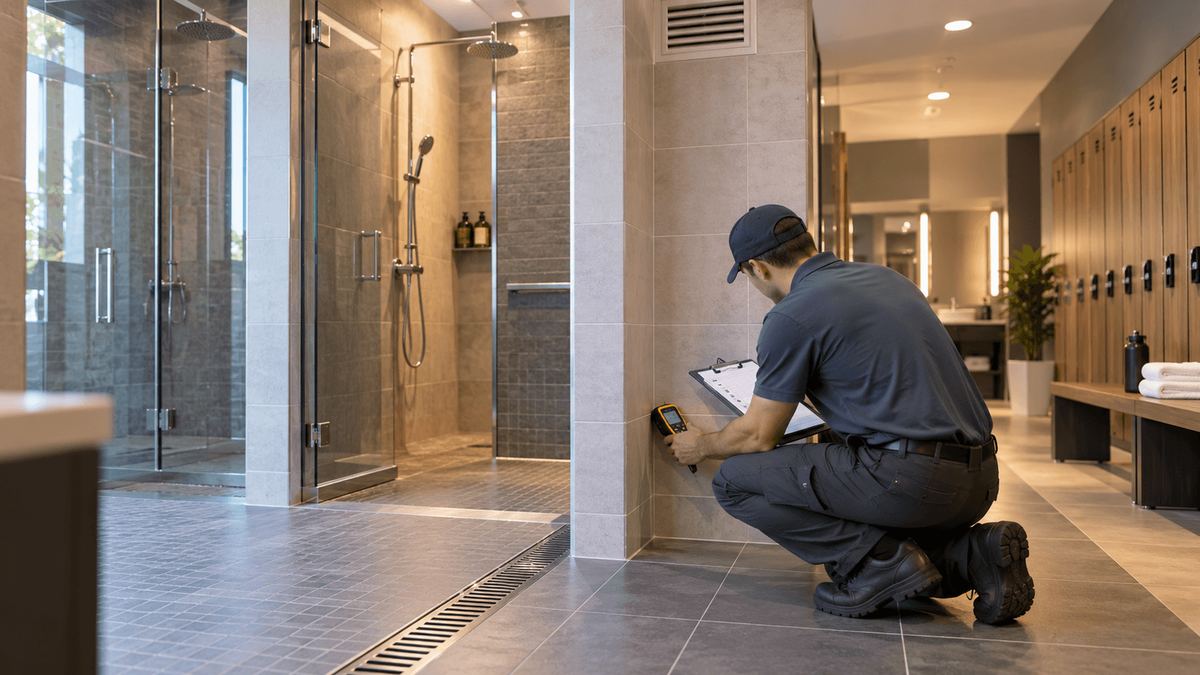
Start at the shower area. Look for failed or missing sealant, cracked grout or tile, loose fixtures, slow drains, standing water, discoloration, softened finishes, and water escaping under doors or partitions. Confirm that floor slopes and drain paths are functioning as intended. Do not probe concealed assemblies or disturb suspect material beyond the worker's training and authorization.
Continue through changing and locker areas. Check the bases of lockers and benches, wall-floor intersections, mats, upholstered seating, and stored supplies. Wet items packed tightly against walls can slow drying. A musty odor, repeated condensation on cool surfaces, or damage behind movable furnishings should be recorded and investigated rather than masked with fragrance.
Inspect plumbing points, including sinks, toilets, drinking fountains, bottle fillers, hose connections, and accessible valves. Look for active drips, mineral tracks, corrosion, swollen cabinetry, damaged wall finishes, and staining below penetrations. Touching or operating components may not be appropriate if there is an electrical, sanitary, structural, or contamination concern.
Observe ventilation without assuming that sound equals performance. Note whether exhaust grilles are obstructed or heavily loaded with dust, whether doors and transfer paths have changed, and whether condensation persists after use. Maintenance staff may verify equipment operation within their scope, while airflow measurement, balancing, controls, or design questions may require an HVAC professional.
Check ceiling and wall areas around cold pipes, diffusers, exterior walls, and roof interfaces. Condensation may form where humid air meets a cool surface. Insulation gaps, damaged vapor control layers, or air leakage can create a recurring problem that surface cleaning will not solve. Record indoor conditions and operating context when possible, but do not treat one humidity reading as a complete diagnosis.
Document Conditions So Patterns Are Visible
Use a route-based checklist with location names that match the building. Record date, time, occupancy condition, weather context when relevant, visible moisture, odor, material condition, equipment status, and immediate action. Photographs from repeatable viewpoints can help teams compare a seam, stain, or ceiling area over time.
Describe observations without making unsupported conclusions. "Dark spotting on painted wall beside shower entrance" is more useful than declaring a mold species from appearance. "Condensation remained on supply pipe 30 minutes after peak use" is more useful than calling the HVAC system defective without evaluation. Clear observations support better handoffs.
Link the inspection to work orders. A finding should have an owner, priority, target date, and closure evidence. Closure might include a repaired fitting, restored exhaust, dried material, removed damaged material, professional assessment, or follow-up reading. Closing the work order because the surface was wiped does not show that the moisture source was corrected.
Track recurrence. If the same location appears repeatedly, elevate it for a broader review. Trends may point to operating schedules, fixture use, cleaning methods, occupant behavior, envelope conditions, or an assembly problem. A recurring issue deserves more than repeated cosmetic repair.
Common Mistakes and Misconceptions
One mistake is assuming tile makes the entire area waterproof. Tile and grout are finish components, while water management depends on the complete assembly. Cracks, penetrations, transitions, membranes, drains, and adjacent materials can determine where moisture travels.
Another misconception is that a bleach odor proves a mold problem was solved. Cleaning product choice does not replace correction of the moisture source, safe work practices, material evaluation, and drying. Employees should follow product labels, avoid unsafe chemical mixing, and use procedures appropriate to the affected material and scope.
Teams may rely too heavily on a single moisture-meter number. Meters can support comparisons, but readings depend on the instrument, material, settings, contact, and reference conditions. Training should cover the tool's limitations and when a qualified assessment is needed.
It is also a mistake to wait for visible growth. Water stains, swollen trim, soft wallboard, corrosion, repeated condensation, musty odor, or slow drying can justify action before growth is visible. Early documentation may reduce the amount of material affected and make source tracing easier.
Do not assume that every dark mark is mold or that color indicates hazard level. Visual appearance alone does not identify a species or health risk. Property staff should focus on moisture correction, appropriate evaluation, and safe response rather than dramatic labels.
Finally, do not assign untrained employees to disturb suspect materials, enter unsafe cavities, handle contaminated porous material, or perform work requiring protection beyond their preparation. A prevention round should have clear stop points and escalation contacts.
How Training Helps
Training gives teams a shared vocabulary and response sequence. Employees can learn where moisture commonly enters, what signs justify a work order, how to document objectively, and when to stop and escalate.
The Mold Awareness, Prevention & Remediation Training for Property Management Teams from moldtraining.us is a natural fit for property managers, maintenance employees, and others who coordinate moisture concerns, tenant or member communication, documentation, and vendor handoff. The course can support an employer's broader program, but the employer remains responsible for site-specific procedures, supervision, equipment, and regulatory decisions.
Courses provide certificates of completion. A certificate documents completion of the course; it does not guarantee licensure or authorize work outside a person's qualifications. Mold-related licensing, assessment, remediation, and notice requirements vary. Learners and employers should review applicable state and local requirements before offering services or assigning regulated work.
Training should include facility-specific practice. Walk the actual inspection route, identify photo restrictions, locate shutoffs and emergency contacts, review work-order categories, and discuss what happens after hours. A short scenario, such as water escaping from a shower into an adjacent office, can test the handoff from front desk to maintenance to management.
Frequently Asked Questions
How often should locker rooms be checked?
Frequency should reflect use, building history, equipment, staffing, and local requirements. High-use shower areas may need observations during daily operations, while a more detailed documented round may occur on another schedule. Add checks after leaks, drain backups, HVAC failures, unusual odors, complaints, or renovation work.
Does a humidity reading prove mold will or will not grow?
No. A reading describes conditions at one place and time. Surface temperature, material moisture, airflow, duration, and hidden conditions also matter. Use readings as part of a documented assessment and trend, not as a universal clearance threshold.
Should staff test every suspected area for mold?
Routine sampling is not always necessary to make a moisture-control decision. EPA guidance notes that visible mold often does not require sampling, while specific situations may benefit from qualified professional input. Follow the facility's procedure and applicable state or local rules.
What should staff do when they find active water?
Protect people from slip, electrical, sanitation, and structural hazards; control the source if authorized and safe; isolate the area as needed; notify the responsible supervisor; document the condition; and begin an appropriate drying or professional-response plan. Escalate immediately when the source or scope exceeds staff capability.
Can front-desk or cleaning staff perform the checks?
They can be trained to notice and report defined conditions within their roles. They should not be expected to diagnose assemblies, disturb suspect materials, or perform technical work without appropriate training, authorization, and protection. The checklist should make those boundaries clear.
Does course completion make someone a licensed mold professional?
No. The moldtraining.us courses provide certificates of completion and do not guarantee licensure. Requirements vary by state and locality, so employers and learners should check the rules that apply to the work and location.
A Practical Next Step
Walk one locker-room route during peak use and again after closing. Note where water is generated, where it should drain, how vapor is exhausted, which surfaces stay damp, and what adjacent spaces could be affected. Compare observations with recent work orders and cleaning schedules.
Then create a one-page route for staff. Name each checkpoint, define observations that trigger immediate escalation, identify the person who opens and closes the work order, and set a follow-up time. Add privacy instructions for photographs and clear limits on disturbing materials.
Conclusion
Fitness-center mold prevention begins with controlling moisture where showers, locker rooms, plumbing, ventilation, and daily operations meet. A repeatable route helps property teams catch changes, document objective conditions, assign repairs, and verify follow-up before small issues become recurring ones.
Training strengthens that routine by teaching employees what to observe, how to report it, and when to involve qualified help. Pair role-appropriate education with site procedures, supervisor review, and current state and local requirements. That combination supports better prevention without overstating what a checklist or certificate can guarantee.
Sources
- United States Environmental Protection Agency, A Brief Guide to Mold, Moisture and Your Home
- United States Environmental Protection Agency, Publications About Mold
- Centers for Disease Control and Prevention, Mold
- National Institute for Occupational Safety and Health, Dampness and Mold Assessment Tool Instructions