
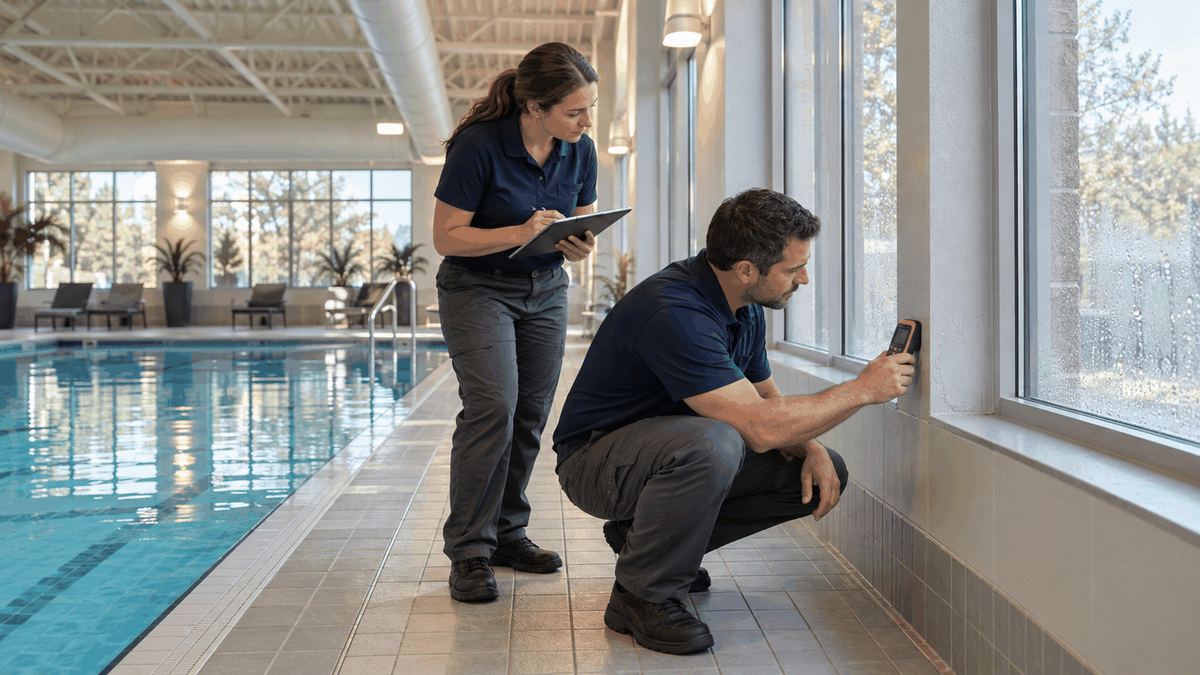
Indoor pool areas create steady moisture loads, so property teams need a repeatable way to spot condensation, record changes, and route repairs early. Unlike a single pipe break or appliance leak, moisture around a pool can develop during normal operations as water evaporates and warm air reaches cooler windows, walls, pipes, doors, or ceiling assemblies. A useful prevention routine connects what aquatics staff, housekeeping, maintenance, and managers observe with a clear process for investigation and follow-up.
Why Indoor Pool Areas Need a Moisture-Control Routine
An indoor pool area is different from an ordinary occupied room because water is continuously present and the space may experience changing activity, air movement, and surface temperatures. Condensation can appear when moisture in the air reaches a cooler surface. Water may also travel beyond the deck through wet towels, cleaning activity, splashing, plumbing problems, or poorly draining areas. None of these observations alone proves that mold is present, but each can justify a closer look at the moisture source and affected materials.
Routine checks help teams notice patterns instead of treating each wet spot as an isolated event. Condensation on the same frame, a recurring damp ceiling tile, or staining that returns after wiping should be documented and routed for evaluation. A dated record helps a qualified technician compare observations with equipment operation, occupancy, earlier work orders, and the building's moisture-control strategy.
The goal is not to turn every employee into a mold inspector or mechanical specialist. Front-line staff can be trained to recognize and report conditions without naming a substance, diagnosing a health concern, or changing specialized equipment beyond their authorization. Managers can then assign the right person to investigate ventilation, drainage, plumbing, insulation, or enclosure conditions.
What Property Teams Should Check
A pool moisture round should cover more than the water's edge. Staff can begin with the perimeter of the room, including glazing, exterior walls, door frames, ceiling transitions, columns, and penetrations. Look for visible condensation, water trails, peeling finishes, swollen materials, rust, discoloration, or recurring dampness. Record the exact location and extent of the observation instead of using a general note such as "pool area wet."
Adjacent spaces also deserve attention. Locker rooms, closets, offices, corridors, and rooms above or below the pool may contain porous finishes that hold moisture. Note damp carpet, wet ceiling tile, soft wallboard, pipe condensation, or stored cardboard touching a damp surface. Do not open walls or disturb suspect material unless the work is within assigned duties and training.
Deck and drainage observations can reveal patterns. Note standing water after cleaning, slow or obstructed drains, damaged sealant, recurring wet areas away from expected splash zones, and water crossing into adjacent rooms. Report the condition through the maintenance process without treating it as proof of a specific defect.
Building systems provide useful clues, but employees should stay within assigned roles. A trained worker may record an alarm, unusual noise, visible condensate, blocked grille, damaged door closer, or approved display status. Pool ventilation, dehumidification, pressure, or temperature adjustments should follow site procedures and be handled by qualified personnel when appropriate.
Record the date and time, precise location, visible condition, recent activity if known, permitted photographs, work-order number, person notified, and planned follow-up. A humidity or moisture reading can add context, but one reading does not identify mold or prove that an assembly is dry. Follow written procedures for instruments, locations, and interpretation.
A Repeatable Inspection and Handoff Workflow
Consistency matters more than an elaborate form. A practical workflow can begin when aquatics, housekeeping, security, or maintenance staff sees condensation, damp material, a musty odor, staining, or an unexpected change. The employee records the observation without diagnosing it, protects people from an obvious slip or access hazard within site procedures, and sends the report to the designated maintenance or management contact.
The assigned responder can compare the report with previous entries and inspect the accessible area. Useful questions include whether the condition is new or recurring, whether it changes with pool activity, whether nearby materials are wet, whether a plumbing or drainage issue is visible, and whether equipment has an alarm or recent service history. If the source or extent is uncertain, the manager can involve a qualified building, mechanical, indoor environmental, or remediation professional as appropriate.
Every handoff should name an owner and a recheck point. A work order marked complete because water was wiped away may not show that the source was corrected. The record should identify what was repaired or adjusted, what materials were dried or removed, who performed the work, and when the area will be reviewed again. Recurring conditions should be escalated through the property's maintenance and management process instead of repeatedly closed as unrelated housekeeping calls.
Communication should remain factual. Staff can describe the observed condition, temporary steps, and next scheduled action. They should not promise that a space is mold-free, interpret health symptoms, or guarantee an outcome. Direct health concerns to an appropriate health professional while the property addresses the building condition.
Common Mistakes and Misconceptions
One mistake is assuming that a familiar pool smell explains every odor in the area. Odor alone does not identify mold, a chemical condition, or a mechanical problem. A musty or unusual odor is a reason to document the location and request investigation, not a substitute for finding the moisture source.
Another mistake is treating visible condensation as normal simply because the room contains a pool. Some condensation may occur, but persistent or recurring water on building materials deserves attention. Repeatedly wiping a window sill, painting a stained wall, or replacing a ceiling tile without investigating why it becomes wet can hide the pattern without correcting it.
A third mistake is relying on a single meter reading or short air sample to clear an area. Readings are snapshots that require context, and routine mold air sampling is not a universal answer for building moisture concerns. Visual observations, moisture history, material condition, and source correction often provide more useful direction for the next decision. Specialized testing, when warranted, should be designed and interpreted by a person with appropriate experience.
Teams can also create risk by asking employees to work outside their roles. Pool staff should not remove wall materials, collect samples, or change complex equipment settings unless those duties are covered by site procedures, training, and authorization. Property managers should define escalation points before an incident, including when to call mechanical contractors, building-envelope professionals, indoor environmental consultants, or remediation providers.
How Training Helps
Role-based training gives departments a shared vocabulary for moisture observations and handoffs. Aquatics and housekeeping employees can learn what to report and what not to disturb. Maintenance staff can connect observations to work orders and repeat checks. Managers can practice assigning responsibility, communicating carefully, preserving records, and recognizing when the situation needs specialized support.
The Property Management Mold Training course from moldtraining.us is a natural fit for property managers, facility supervisors, and maintenance leads who coordinate moisture reports, occupant communication, repairs, vendors, and follow-up. Mold Prevention and Remediation Awareness Training may fit front-line employees who need basic recognition, reporting, and response boundaries. Employers should match training to actual duties and add site-specific instruction for the pool, building systems, emergency contacts, and work-order process.
These courses provide certificates of completion. A certificate documents course participation, but it does not guarantee licensure or authorize a learner to perform every type of mold inspection or remediation work. Learners and employers should review applicable state and local requirements before assigning regulated or specialized services.
Frequently Asked Questions
Does condensation around pool windows mean mold is present?
No. Condensation shows that moisture in the air reached a surface cool enough for water to form, but it does not establish that mold is present. Staff should dry accessible wet surfaces within their role, record where and when condensation appeared, and report recurring conditions so the facility can evaluate humidity, air movement, surface temperature, insulation, and equipment operation.
What should staff record during a moisture round?
Record the date and time, exact location, visible condition, approximate area, recent pool activity if known, photographs permitted by policy, related equipment alarms or work orders, person notified, and planned recheck. Use objective terms such as "water droplets on the north window frame" rather than conclusions such as "toxic mold." Consistent descriptions make repeated conditions easier to compare.
Should pool or housekeeping staff collect mold samples?
Not as a routine response unless sampling is part of an approved plan and the employee has the appropriate training and authorization. Federal guidance emphasizes moisture control and careful visual assessment, and routine air sampling may not answer the practical question of why materials are getting wet. A qualified professional can determine whether sampling would add useful information in a particular situation.
Is a musty odor proof of mold?
No. A musty odor is a useful observation, but it does not identify a substance, source, or health risk. Staff should record where the odor is noticed, whether it changes over time, and whether damp or damaged materials are visible. The next step is to investigate moisture and building conditions without making unsupported claims to occupants.
Does completing a moldtraining.us course make someone a licensed mold inspector?
No. Moldtraining.us courses provide certificates of completion and education suited to their stated audiences. They do not guarantee licensure. Licensing, registration, and scope-of-practice rules can vary, so learners and employers should check current state and local requirements before offering inspection, sampling, assessment, or remediation services.
A Soft Next Step for Property Teams
A property team can start by walking the pool area and adjacent rooms with a short checklist, then comparing the observations with recent work orders. Assign one person to receive reports, one person to coordinate investigation, and a clear date for rechecking completed work. The checklist should fit the building rather than copying a generic form without considering its systems and staff roles.
Managers seeking a consistent foundation can consider Property Management Mold Training for team leads and awareness training for front-line staff. Training should support site procedures and qualified technical help. Periodic record reviews can show whether reports are clear, handoffs are timely, and recurring conditions reach the people responsible for correction.
Conclusion
Indoor pool moisture control works best as a shared operating routine, not a reaction reserved for visible growth or major water events. Clear observations, defined handoffs, appropriate training, source correction, and documented rechecks help property teams respond within their roles and involve qualified specialists when needed.
Sources
U.S. Environmental Protection Agency, Mold Remediation in Schools and Commercial Buildings Guide: Chapter 1, https://www.epa.gov/mold/mold-remediation-schools-and-commercial-buildings-guide-chapter-1
U.S. Environmental Protection Agency, Mold Course Chapter 9: Prevention, https://www.epa.gov/mold/mold-course-chapter-9
U.S. Environmental Protection Agency, A Brief Guide to Mold, Moisture and Your Home, https://www.epa.gov/mold/brief-guide-mold-moisture-and-your-home
Centers for Disease Control and Prevention, National Institute for Occupational Safety and Health, Mold in the Workplace, https://www.cdc.gov/niosh/mold/about/
Centers for Disease Control and Prevention, National Institute for Occupational Safety and Health, Mold, Testing, and Remediation, https://www.cdc.gov/niosh/mold/testing-remediation/index.html