
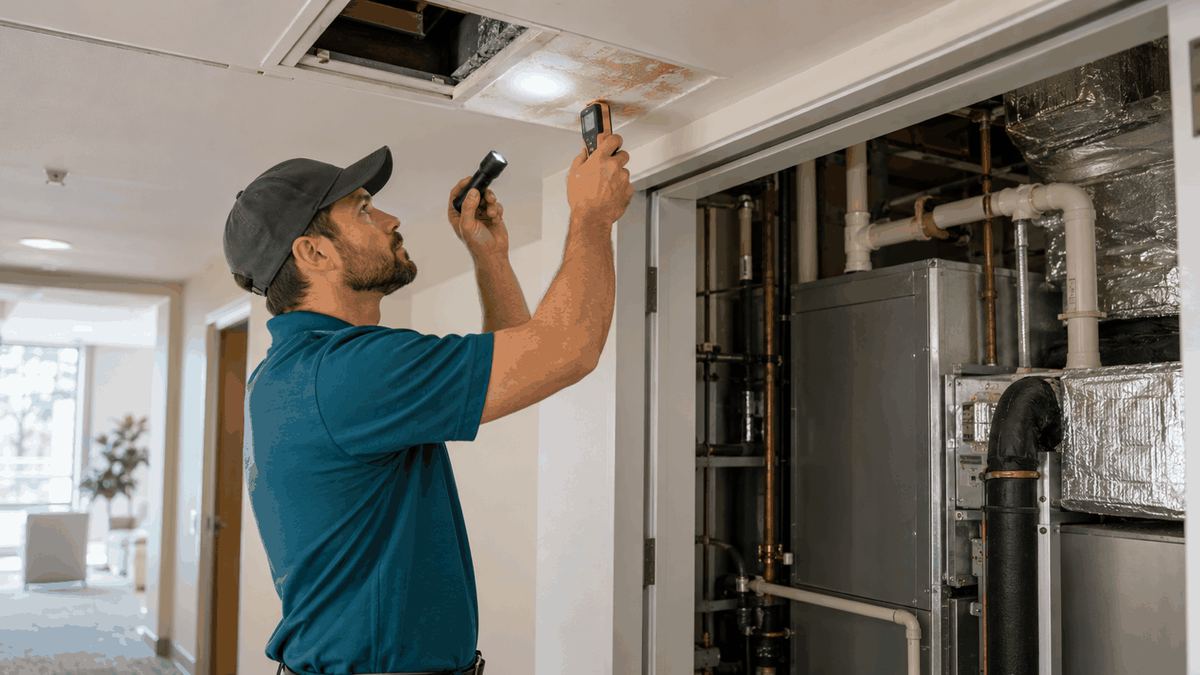
After a plumbing repair, facilities teams should verify drying, document moisture concerns, and decide whether assessment is needed before closing the area.
Why Moisture Follow-Up Matters
Stopping a leak is only the first step. Water can remain behind a wall, above a ceiling, under flooring, inside insulation, or around a cabinet long after the visible drip has stopped. If the team closes the area too quickly, hidden moisture may support mold growth or create a repeat complaint. A follow-up routine helps maintenance staff move from emergency response to verification.
The routine should be practical for apartments, offices, schools, retail spaces, and other buildings. It does not require every employee to diagnose a building or perform remediation. It gives the team a consistent way to identify what happened, what was dried, what remains uncertain, and when a specialist or building owner should be involved.
EPA explains that moisture control is central to mold control. A facilities team can apply that principle without promising a mold-free building or relying on a universal federal mold threshold. Conditions, materials, occupants, building design, and state or local requirements may affect the response.
What Facilities Teams Should Check
Begin with the source and the repair. Record the room, date, type of plumbing failure, affected materials, shutoff action, repair completed, and any area that was opened. Note whether water was clean supply water, wastewater, condensate, or an unknown source. The source description helps determine the next review and whether additional health or safety controls are needed.
Then inspect the visible area. Look for staining, soft materials, swelling, peeling finishes, damp odors, condensation, and changes in temperature or ventilation. Check both the repaired location and nearby materials that may have received water. A dry surface does not prove the assembly is dry, so the team should record what was observed and what method was used.
Use moisture measurements consistently when the employer has an appropriate meter and trained staff. Record the instrument type, locations, readings, comparison areas, and date. Meter readings can vary with material, temperature, salts, and surface conditions, so they should support a broader evaluation rather than stand alone. If the reading is uncertain or the material cannot be assessed, note the limitation.
Inspect building operations. A plumbing repair may be followed by a closed ceiling, blocked air movement, a disabled exhaust fan, or furniture pushed against a damp wall. Confirm that ventilation, dehumidification, and access support drying. If HVAC components or insulation were affected, the team should follow the building's escalation process instead of assuming routine cleaning is enough.
Document the drying plan. The record should name the responsible person, equipment used, affected rooms, target review date, and decision point for opening materials or calling a specialist. Photos should show the location and condition without exposing private resident information. Store the record where maintenance, property management, and vendors can find it.
How Training Helps
The relevant moldtraining.us course can help facilities teams learn a common vocabulary for moisture, visible growth, documentation, communication, and prevention. Training is most useful when it is connected to the building's work orders and escalation process. A maintenance technician may need to recognize a hidden-moisture clue, while a property manager may need to explain the next step to an occupant without making an unsupported health claim.
Courses provide certificates of completion, but they do not guarantee licensure, inspection authority, remediation authority, or a particular outcome. Employers should direct staff to state and local requirements before assigning regulated work. Training should complement, not replace, the building's procedures, qualified evaluation, or professional advice when conditions are complex.
Role-based instruction can cover the full handoff. The person receiving the complaint records the report accurately. The technician controls the source and protects the area. The supervisor checks documentation and decides whether more assessment is needed. The vendor receives a clear scope and known conditions. Occupants receive factual information about what was found and what will happen next.
Training can also improve prevention. Teams can look for recurring failures such as loose supply connections, slow drains, failed caulk, condensate overflow, roof leaks, and poor bathroom ventilation. A trend in work orders may point to a maintenance or capital need. The goal is not to make a guarantee about future mold conditions, but to improve the building team's ability to notice and respond to moisture early.
Common Mistakes and Misconceptions
One common mistake is closing the wall as soon as the pipe is repaired. If the area cannot be inspected, the team loses information about drying and later may not know what materials were affected. Another mistake is relying on odor alone. Odor can be a useful clue, but its absence does not prove that moisture is gone.
Some teams treat a small leak as harmless because the visible area is limited. Water can travel along framing, pipe chases, and flooring, so the inspection should consider adjacent materials. Other teams overreact to every mark as proof of a mold problem. A stain may have several causes. The responsible approach is to document the observation, evaluate moisture, and escalate when the condition exceeds the team's role.
Do not promise that a cleaning product will solve the problem. Do not represent a certificate of completion as a license or as EPA, OSHA, or CDC certification. Do not state that a federal agency has approved a provider, inspector, person, or course unless a specific official program actually says so. Communicate what is known, what is being checked, and what requirement or professional decision governs the next step.
Do not discard the record after the work order closes. Repeated plumbing repairs in the same stack, room, or building can show a pattern. Keep photos, readings, vendor notes, and completion dates according to the property's retention practice. A consistent file can help the team compare future incidents and explain maintenance decisions.
Frequently Asked Questions
How soon should a team recheck after a repair?
The timing depends on the amount of water, material, ventilation, temperature, and building conditions. The team should set a documented follow-up rather than relying on a generic calendar. A wet ceiling assembly or enclosed wall may need earlier review and a qualified evaluation.
Is a moisture meter enough to clear a room?
No. A meter reading is one piece of information. The team should consider the source, materials, visual condition, comparison areas, drying conditions, and any limitations of the instrument. Clearance decisions should follow the employer's process and any applicable state or local requirements.
Should maintenance staff remove every stained material?
Not automatically. Staff should work within their training, employer procedures, and applicable requirements. They should protect occupants, document the condition, and escalate materials or contamination that require specialized assessment or remediation.
Does a mold course provide a license?
Courses provide certificates of completion and do not guarantee licensure. State and local requirements may apply to inspection, assessment, remediation, or contractor work, so the employer should verify the rules where the work occurs.
What should an occupant be told?
Give factual information about the repair, the area being checked, access expectations, and the next update. Avoid diagnosing a health condition or promising that a particular product or procedure guarantees a result. Route medical questions to a qualified healthcare professional.
A Simple Follow-Up Workflow
Close the source, protect the area, and record the repair. Identify materials and spaces that may have been affected. Inspect visible conditions and use consistent measurements when appropriate. Improve airflow or dehumidification through the building's normal process. Set a review date and name the person responsible.
At the follow-up, compare the location with the original notes. Record whether materials are dry or still uncertain, whether stains or odors changed, and whether access must be expanded. If the condition is outside the team's role, document the escalation and provide the specialist with the repair history, photos, readings, and building information.
After completion, review the work order for prevention opportunities. Ask whether the repair suggests a recurring component failure, a ventilation issue, an occupant communication need, or a capital maintenance item. A short after-action review can help a facilities team improve without assigning blame or making claims the evidence cannot support.
Property teams can make the workflow easier by adding a moisture follow-up field to the ordinary work order. The field can require a source description, affected area, first inspection, follow-up date, readings when used, photographs, escalation decision, and final note. A consistent workflow reduces the chance that a repair is marked complete before the building team has considered the materials around it.
Conclusion
Plumbing repairs should end with verification, not just a closed valve and a completed invoice. A repeatable moisture check helps facilities teams document affected materials, support drying, communicate clearly, and recognize when more expertise is needed. The moldtraining.us course can support role-based learning, while certificates of completion remain distinct from licensure and local requirements. Keep the process factual, practical, and connected to moisture control.
Sources
U.S. Environmental Protection Agency, A Brief Guide to Mold, Moisture and Your Home https://www.epa.gov/mold/brief-guide-mold-moisture-and-your-home
U.S. Environmental Protection Agency, Ten Things You Should Know About Mold https://www.epa.gov/mold/ten-things-you-should-know-about-mold
U.S. Environmental Protection Agency, Indoor AirPlus and Viruses, Bacteria and Mold https://www.epa.gov/indoorairplus/indoor-airplus-and-viruses-bacteria-and-mold