
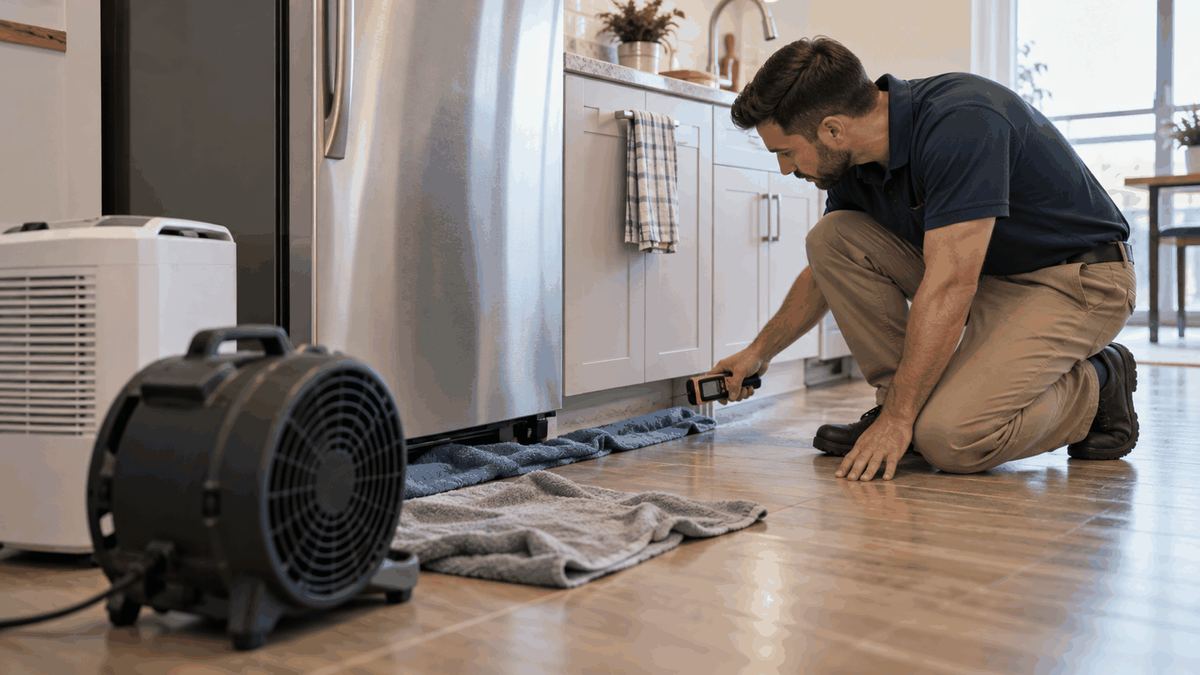
After an appliance leak, maintenance teams need a documented drying routine that connects the water source, affected materials, and next decision.
Small leaks from dishwashers, refrigerators, washing machines, ice makers, and supply connections can wet flooring, cabinets, wall bases, and concealed spaces. The visible water may be limited while moisture remains under a cabinet, behind trim, or beneath resilient flooring. A practical response focuses on stopping the source, documenting the affected area, supporting drying, and deciding when additional inspection or professional help is appropriate.
This article is for property managers, maintenance staff, resident services teams, vendors, and building owners. It is general educational information, not a diagnosis, remediation specification, health determination, or legal advice. State and local requirements, lease obligations, insurance requirements, and qualified professionals may add steps.
Why Appliance Leaks Need a Repeatable Routine
An appliance leak creates a handoff problem. A resident may report water to a leasing office, a dispatcher may send a technician, and a restoration vendor may arrive later. If each person records a different description, the team may not know when the leak stopped, what materials were wet, or whether drying was verified.
EPA guidance identifies moisture control as central to mold prevention and recommends drying water-damaged areas and items promptly. The exact response depends on the material, amount of water, duration, source, and building conditions. A routine helps a team gather the information needed for that judgment without treating a single moisture-meter reading as proof that every concealed area is dry.
The goal is not to promise a mold-free building or a particular health outcome. The goal is to make the first response consistent, limit avoidable spread, preserve observations, and route uncertain or extensive conditions to people with the right experience and equipment.
What the Maintenance Team Should Document
Start with the source. Record the appliance, supply line, drain, valve, pan, or connection involved, along with when the leak was reported and when it was stopped. Photograph the source and the surrounding area before moving items when practical. Note whether the water appears clean, contaminated, or unknown, and follow the property's safety procedure for uncertain sources.
Describe the affected materials. Identify flooring, pad, cabinets, drywall, insulation, baseboards, furniture, stored items, and any penetrations or seams that may hold moisture. A room name alone is not enough. Use a simple sketch, photographs, measurements, or an asset location so the next person can return to the same area.
Document occupant or worker concerns without making a medical conclusion. Record reported odor, visible staining, repeated leaks, or access limits as observations. Do not label a symptom as caused by mold, and do not promise that drying will resolve a health complaint. Refer health questions to an appropriate medical professional and building questions to qualified personnel.
Keep a time line. Note the first report, source control, initial inspection, equipment placement, follow-up readings, material removal or repair, and final review. The time line supports a defensible handoff and makes it easier to see when a delay occurred.
How Drying Verification Works
Drying is a process, not just equipment placement. Fans and dehumidifiers may help, but they need to be positioned safely and used with attention to air movement, electrical conditions, occupant access, and the materials involved. The team should identify who checks the equipment, how often, and what happens if it stops or the area remains damp.
Moisture meters can support comparison when used by trained personnel. Record the instrument, setting or material type, location, date, and result. A number without context can be misleading because materials vary and meters have limitations. Compare affected materials with a reasonable dry reference when the procedure calls for it, and recognize that a surface reading may not describe a concealed cavity.
Look for patterns rather than a single result. A cabinet toe-kick may be dry on the front but wet behind it. Flooring may feel dry while a pad or subfloor remains affected. A wall base may show no visible change while moisture traveled along the bottom plate. The inspection should include edges, seams, penetrations, adjacent rooms, and areas below or behind the appliance when safe and accessible.
Drying verification also includes conditions that can slow progress. Closed cabinets, poor airflow, high indoor humidity, cold surfaces, absorbent materials, and ongoing plumbing problems may require a different plan. If the team cannot reach the affected material or cannot interpret the result confidently, record the limitation and escalate.
How Training Helps
The relevant Mold Prevention Training for Property Teams course on moldtraining.us can help property staff build a shared vocabulary for moisture observations, response documentation, prevention, and handoffs. A course can support awareness and consistent habits, but it does not replace a site-specific assessment, a qualified remediation plan, or state and local requirements.
Training is most useful when the team practices with its own work order and inspection form. Staff can rehearse how to identify the source, photograph the area, describe materials, place drying equipment, record meter readings, and schedule follow-up. The exercise should include an easy case and a difficult case with hidden moisture or limited access.
Dispatch and resident services staff need a simple intake script. Ask where the water is, when it was noticed, whether the source is still active, whether power or electrical equipment is affected, and whether anyone needs immediate assistance. Avoid asking residents to diagnose mold. The information should help the technician arrive prepared and should not turn the caller into an investigator.
Maintenance staff need role clarity. One person may stop the leak, another may document, and a vendor may evaluate materials. The handoff should identify what has been done, what remains wet, what equipment is operating, and who owns the next check. Training can expose where a property relies on informal memory instead of a durable record.
Managers need escalation practice. A small, accessible area may fit the routine maintenance process, while extensive water damage, sewage, hidden cavities, repeated failures, suspected HVAC involvement, or occupant displacement may require specialized support. The course can help staff recognize when to pause and refer, but it cannot determine every project boundary.
Common Mistakes and Misconceptions
One misconception is that visible water removal means the building is dry. Moisture may remain below flooring, behind cabinets, or in wall materials. Another is that an air mover guarantees a result. Equipment supports drying only when the source is controlled, conditions are monitored, and affected materials are accessible.
Do not use color or odor as a complete assessment. A musty odor may be a useful observation, but it does not identify the source or establish the extent. A clean-looking surface may still conceal moisture. Record what is known and what requires further evaluation.
Avoid documenting only the final reading. The starting condition, affected materials, equipment, access limits, and follow-up timing are part of the story. A later reviewer needs enough context to understand whether the result is comparable and whether the leak returned.
Do not promise residents that a course certificate makes someone licensed, certified, or qualified for every mold-related task. Courses provide certificates of completion and do not guarantee licensure. Direct staff and property owners to applicable state and local requirements and to qualified professionals when the situation exceeds routine maintenance.
Avoid moving contaminated or heavily damaged materials through occupied areas without a plan. Follow the property's containment, protection, waste, and vendor procedures. When the water source or material condition is uncertain, seek qualified guidance before expanding the response.
Frequently Asked Questions
Does a moisture meter prove that an area is safe?
No. A meter provides information that may support a drying review when used correctly and interpreted with the material, location, and reference conditions in mind. It does not identify every concealed wet area, determine a health risk, or replace a qualified assessment.
Should maintenance staff remove cabinets after a small leak?
Not automatically. The decision depends on access, damage, construction, safety, the ability to dry the space, and the property's procedure. Document the limitation and refer when hidden moisture cannot be evaluated through routine methods.
How quickly should a team respond?
The team should respond promptly because delay can allow moisture to spread and can complicate drying. The exact timing and actions depend on the material, source, amount of water, and applicable procedure. Record when the report was received and when source control began.
Is a musty odor proof of mold growth?
No. Odor is an observation that may justify further evaluation, but it is not proof of a specific condition or cause. Record where it was noticed, whether it persists after drying, and what qualified follow-up is planned.
Do moldtraining.us courses provide a license?
No. The courses provide certificates of completion and do not guarantee licensure. Staff should follow state and local requirements and confirm whether a particular task requires additional education, licensing, or qualified professional oversight.
Brief Conclusion
Appliance leaks are easier to manage when the property team can connect source control, material inspection, drying equipment, moisture verification, and follow-up in one record. Training supports that routine by giving staff shared language and clear escalation points. The practical next step is to review one recent appliance leak and identify which observation or handoff was hardest to verify.
Sources
U.S. Environmental Protection Agency, A Brief Guide to Mold, Moisture and Your Home https://www.epa.gov/mold/brief-guide-mold-moisture-and-your-home
U.S. Environmental Protection Agency, Mold Course Chapter 4: General Remediation Issues https://www.epa.gov/mold/mold-course-chapter-4
U.S. Environmental Protection Agency, Mold Cleanup in Your Home https://www.epa.gov/mold/mold-cleanup-your-home