
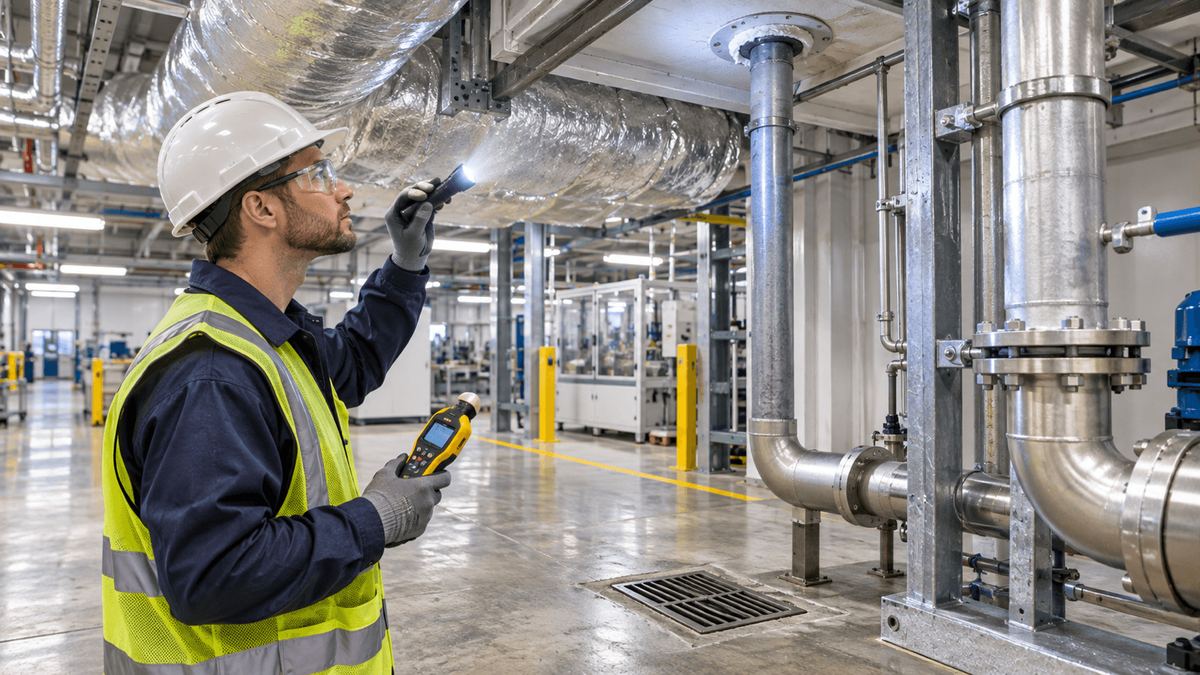
Manufacturing facilities need organized moisture checks because process water, roofs, drains, piping, and HVAC systems can wet nearby building materials. A small leak behind equipment may remain unnoticed until it affects insulation, wall finishes, packaging, stored materials, or an adjacent office.
The goal of a moisture program is not to turn every maintenance employee into a mold inspector. It is to help property and facilities teams recognize water pathways, protect people and operations, document conditions, correct sources, support appropriate drying, and escalate work that exceeds their training.
Different operations have different hazards. Food production, machining, assembly, printing, warehousing, laboratories, and light manufacturing can involve chemicals, energized equipment, hot surfaces, traffic, pressure systems, and regulated production areas. Moisture checks must fit the facility's safety, sanitation, quality, and shutdown procedures.
Where Moisture Develops in Manufacturing Facilities
Process water deserves a system map. Mark supply lines, wash stations, cooling loops, condensate drains, tanks, pumps, valves, hose connections, floor trenches, and areas that are cleaned with water. Include shutoffs, containment, alarms, and the people authorized to isolate equipment.
Look beyond an obvious drip. Water can travel along piping, cable trays, structural members, wall cavities, insulation, and sloped floors. The wet spot may be several feet from the source. Record both the discovery point and the suspected path without declaring a cause before it is verified.
Roofs are another common pathway. Large manufacturing roofs may contain many drains, scuppers, curbs, skylights, exhaust penetrations, vents, expansion joints, and equipment supports. Wind-driven rain, ponding, damaged flashing, clogged drains, or a recent roof repair can affect ceilings, insulation, offices, mezzanines, and stored materials.
HVAC and process ventilation can create condensation when humid air reaches a cold surface. Chilled-water piping, ducts, diffusers, drain pans, coils, refrigeration lines, and insulated equipment deserve routine checks. Wet insulation jackets, corrosion, staining, dripping, and repeated condensation are conditions to document and correct.
Floor drains and trenches can back up, lose trap seals, collect debris, or receive more flow than intended. Staff should observe drainage from a safe position and follow facility procedures. They should not open guarded equipment, enter pits, reach into machinery, or mix cleaning chemicals while investigating moisture.
Building-envelope joints, dock doors, wall penetrations, below-grade areas, and slab edges can admit water during rain or snowmelt. A recurring damp spot near the exterior may relate to grading, drainage, seals, wall assemblies, or underground conditions. Repeated events need investigation rather than another cosmetic patch.
Building a Practical Moisture Inspection Route
Create an inspection route that reflects operating conditions. A dry-day check can find stains, damaged insulation, corrosion, and blocked access. A check during or after rain can reveal roof and wall pathways. A visit during sanitation, startup, shutdown, or high-humidity production may expose conditions not visible during normal operation.
Use consistent location identifiers. Building, line, bay, column, room, asset number, elevation, and nearby equipment can help another employee find the same place. An overview photograph and a close detail are often more useful than an unlabeled image of a stain.
Document the time, operating state, weather, visible water, odor, affected materials, estimated area, source status, immediate controls, notifications, and follow-up date. Link the finding to a work order so observations, repairs, drying, and verification remain connected.
If the team uses moisture meters, define their purpose and limitations. Readings can vary with material, temperature, salts, depth, calibration, and technique. A meter can help compare locations or follow drying, but it does not prove that mold is present or absent.
Inspect stored materials and packaging. Cardboard, paper, fabric, wood, ceiling tile, insulation, and dust can remain damp even when a concrete floor appears dry. Keep vulnerable materials off wet floors and away from leaking walls, and follow quality procedures for affected product or packaging.
Check hidden transition areas where production meets offices, locker rooms, maintenance shops, laboratories, or warehouses. These spaces may contain paper-faced gypsum board, carpet, acoustic ceiling tile, cabinets, and furnishings that respond differently to moisture than concrete and metal production surfaces.
Responding to Water Without Disrupting Safety
Protect people first. Water near electrical equipment, moving machinery, chemicals, traffic, hot surfaces, unstable ceilings, or contaminated processes can create hazards beyond mold. Follow lockout, spill, electrical, traffic-control, sanitation, and emergency procedures before approaching or cleaning the area.
Control the source when authorized personnel can do so safely. Isolate a line, clear an approved drain obstruction, stop a wash process, protect a roof opening, or adjust equipment under the facility's procedures. Some sources need a plumber, roofer, HVAC technician, engineer, industrial hygienist, restoration contractor, or other qualified professional.
Remove standing water and dry affected materials using methods appropriate to the source, material, area, and facility. Fans should not be started automatically if they could spread dust, contaminants, odors, or process residue. Production requirements and containment needs may change the response.
EPA guidance emphasizes moisture control and prompt attention to wet materials. Property teams should avoid promising that an area is mold-free based on appearance, odor, one meter reading, or a short drying period. Hidden moisture, persistent odors, visible growth, recurring leaks, or extensive affected materials deserve escalation.
Follow-up closes the loop. Verify that the source is corrected, insulation and finishes are dry as appropriate, damaged materials are addressed, production areas are cleaned under applicable procedures, and the work order identifies who made the decision. Reinspect after the system returns to normal operation.
Common Mistakes and Misconceptions
One mistake is assuming that concrete and steel construction eliminate mold concerns. Manufacturing facilities also contain dust, insulation, ceiling tile, drywall, wood, packaging, paper records, fabrics, and adjacent occupied rooms that can remain damp.
Another mistake is treating every ceiling stain as a roof leak. Condensation, plumbing, process lines, fire protection systems, and HVAC equipment can produce similar evidence. Record the condition and investigate the pathway before selecting a repair.
Teams sometimes close a moisture work order when the drip stops. The source may be corrected while wet insulation, wall cavities, packaging, or finishes remain. Verification should include affected materials, not only the valve or roof patch.
Painting over staining without correcting moisture can hide evidence while the condition continues. Cosmetic repair should follow source control, appropriate drying, and material evaluation.
Bleach is not a universal solution. The material, area, source, ventilation, worker protection, and facility process all matter. Employees should use approved procedures and qualified support instead of applying a chemical to every discolored surface.
There is no single federal airborne mold threshold that proves every manufacturing space is safe or unsafe. EPA, OSHA, and CDC do not certify individual mold inspectors or endorse a specific course. State and local rules may govern assessment, remediation, licensing, disclosure, or worker protection.
How Training Helps
Training gives maintenance, engineering, sanitation, warehouse, quality, and property staff a shared language for moisture findings. Employees can learn common sources, safe boundaries, documentation, drying principles, escalation triggers, and the difference between observation and diagnosis.
Mold Awareness Training can fit employees who need to recognize and report moisture or suspected growth without performing assessment or remediation. Property Management Mold Training may better fit supervisors and facilities leads who coordinate work orders, vendors, prevention plans, occupant communication, and records.
The relevant moldtraining.us courses provide certificates of completion and do not guarantee licensure. A certificate supports a training record but does not authorize regulated work. Employers and individuals should check state and local requirements before assigning mold assessment, inspection, or remediation duties.
A useful exercise starts with a simulated leak above a production line. Ask the team to stop at the correct safety boundary, identify notifications, map the water path, protect materials, open a work order, select qualified support, and schedule follow-up after normal operations resume.
For teams that want a structured baseline, a moldtraining.us course can support the next training cycle. Pair the course with the facility's process map, shutdown rules, emergency procedures, vendor contacts, inspection route, and documentation standards.
Frequently Asked Questions
Should maintenance staff test every stain for mold?
No. Staff should document moisture, visible conditions, odors, affected materials, and the source status, then follow the facility's escalation plan. Sampling decisions should be made by qualified people based on the situation and applicable requirements.
How quickly should a leak be addressed?
Act promptly while protecting employees and operations. Control the source, remove standing water, evaluate affected materials, and begin appropriate drying as soon as it can be done safely. The water source, material, area, and facility hazards affect the response.
Can a moisture meter confirm mold?
No. A moisture meter measures a material response that may help locate dampness or compare drying progress. It does not identify mold or prove that mold is absent.
Who should inspect roof and HVAC areas?
Use employees or contractors who are authorized, trained, and equipped for the location and task. Roof access, energized equipment, heights, confined spaces, and process hazards may require additional controls or specialized personnel.
Does a course certificate make someone a licensed mold inspector?
No. Moldtraining.us courses provide certificates of completion and do not guarantee licensure. Licensing and work-scope rules vary, so check state and local requirements before offering or assigning regulated services.
What records should a manufacturing facility keep?
Useful records include inspection routes, moisture findings, photographs, work orders, source repairs, drying checks, affected materials, vendor reports, training, and follow-up verification. Retention should fit company policy and applicable requirements.
Conclusion
Manufacturing moisture prevention works best when the facility connects process systems, roofs, drainage, HVAC, materials, safety, and work-order follow-through. Employees should know where to look, what to record, when to stop, and who can make the next decision.
A short training course can provide a common foundation, but the strongest program combines that learning with site-specific maps, procedures, qualified support, and repeat inspections. Start with one representative route and improve it each time a real moisture event tests the process.
Sources
United States Environmental Protection Agency, Moisture Control Guidance for Building Design Construction and Maintenance - https://www.epa.gov/indoor-air-quality-iaq/moisture-control-guidance-building-design-construction-and-maintenance-0
United States Environmental Protection Agency, Mold Remediation in Schools and Commercial Buildings - https://www.epa.gov/mold/mold-remediation-schools-and-commercial-buildings-guide
United States Environmental Protection Agency, A Brief Guide to Mold Moisture and Your Home - https://www.epa.gov/mold/brief-guide-mold-moisture-and-your-home
Centers for Disease Control and Prevention National Institute for Occupational Safety and Health, Mold in the Workplace - https://www.cdc.gov/niosh/mold/about/