
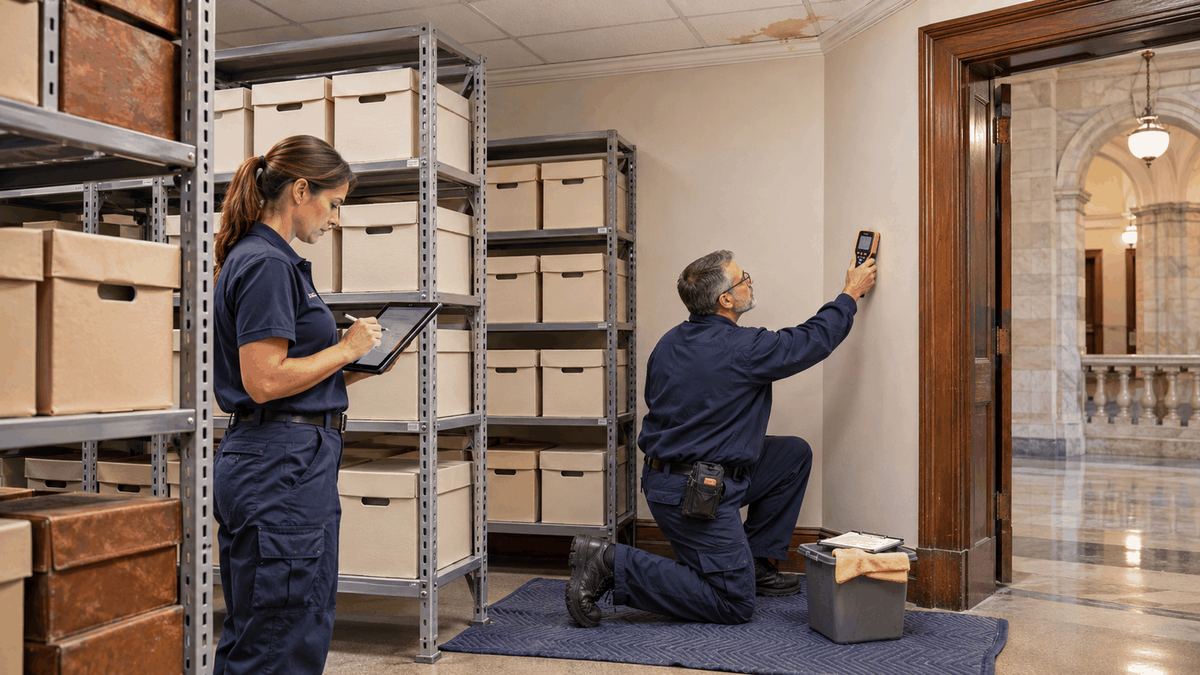
Courthouses need a moisture response plan that protects occupied rooms, secured records, holding areas, and operations without spreading dust or confusion. A roof leak over a courtroom, condensation near an air handler, or a plumbing release beside stored files can affect several departments at once, so early reporting and coordinated decisions matter.
Mold prevention begins with moisture control. Staff do not need to identify a mold species to report damp materials, visible growth, musty odors, condensation, or a recurring leak. They do need a clear route for escalating the observation, protecting people from avoidable disturbance, documenting the location, and getting the water source evaluated.
Why Courthouses Need a Building-Specific Moisture Routine
Courthouses combine public lobbies, courtrooms, chambers, offices, records storage, evidence or property rooms, restrooms, mechanical spaces, and sometimes detention or holding areas. The building may be occupied for long hours, and access to some rooms is restricted. A moisture event can therefore involve facilities staff, court administration, security, records personnel, custodians, contractors, and other agencies.
Older buildings may have complex roofs, masonry walls, basements, pipe chases, and renovations from several periods. Newer buildings may still experience drain backups, envelope leaks, condensation, irrigation intrusion, or HVAC problems. The response process should be based on observed moisture and materials, not on assumptions about building age.
Records and case files add a special concern. Paper, cardboard, fabric, and dust-holding surfaces can retain moisture and are not always easy to clean or replace. Moving wet records without a plan can spread water and disrupt chain-of-custody or retention procedures. Facilities and records personnel should agree in advance on who can move materials, where temporary staging is allowed, and when conservation or specialty help is needed.
Holding areas and secure rooms create different access constraints. A maintenance worker may need an escort, a room may not be available immediately, and occupants may have to be relocated before inspection. Those operational requirements should be included in emergency contacts and after-hours procedures so a delay in access does not become an untracked moisture problem.
Moisture Sources Worth Checking
Roof and flashing problems often appear first as stained ceiling tiles, damp wall finishes, or water near penetrations. Staff should report the first sign and identify the room, floor, time, and recent weather. Replacing a stained tile without tracing the source can conceal a recurring leak.
Plumbing releases can occur near restrooms, break rooms, mechanical rooms, janitor closets, holding cells, and below concealed piping. Shutoff and escalation procedures should be available to authorized staff. The response record should distinguish the source repair from the drying and material evaluation work because both need completion.
HVAC systems can contribute through blocked condensate drains, wet insulation, low surface temperatures, uncontrolled humidity, or water entering outdoor-air components. A musty odor near a diffuser is an observation to investigate, not proof that the duct contains mold. Qualified personnel should inspect the relevant system and avoid actions that could distribute contamination.
Below-grade walls, floor joints, sump systems, and drainage conditions deserve attention in basements and archive areas. Boxes stored directly on floors or against exterior walls can hide dampness. Storage layouts should preserve inspection access and follow the courthouse's records and security rules.
A Practical Response Sequence
First, protect people and limit access when conditions may be unsafe. Water near electrical equipment, damaged ceilings, sewage, extensive visible growth, or structural concerns require escalation beyond routine housekeeping. Staff should not disturb suspect material simply to get a better photograph.
Second, stop or control the water source when trained and authorized personnel can do so safely. A bucket under a drip can reduce immediate spread, but it is not source correction. Create a work request that follows the leak through repair, drying, material decisions, and verification.
Third, document what was observed. Record the exact location, materials affected, visible water, odor, weather, time discovered, access restrictions, and actions taken. Photographs can support the record when security and court policies allow them. Sensitive documents, screens, people, and evidence should not be captured unnecessarily.
Fourth, evaluate the extent of wet materials. EPA guidance for commercial buildings emphasizes fixing the moisture problem, drying wet materials promptly, and planning remediation based on the size and complexity of the situation. Moisture meters can support material evaluation when used by people who understand the material and instrument limitations.
Fifth, communicate by role. Court administration may need operational updates, while facilities teams need technical assignments and security teams need access instructions. Communications should describe known facts, protective actions, and next steps without guessing about health effects or declaring an area clear before the responsible evaluation is complete.
Finally, verify closure. Confirm the source repair, drying or material removal, cleaning, access restoration, and any follow-up inspection. Recheck recurring locations after relevant weather or operating conditions. A closed work order should show what was confirmed, not just that a contractor visited.
Common Mistakes and Misconceptions
One misconception is that a mold test is always the first step. EPA and CDC guidance generally focuses on correcting moisture and addressing visible or suspected growth. Sampling can have specific uses, but a test result does not repair a leak or replace a careful building assessment.
Another mistake is painting over a stain or visible growth. Coating a surface does not correct the moisture source and may hide continuing damage. The material and the cause should be evaluated before cosmetic repair.
Teams sometimes use bleach as a universal response. Materials, contamination extent, ventilation, occupant protection, and product safety all matter. Staff should follow the building's approved procedure and applicable guidance rather than improvising chemical use.
It is also a mistake to wait for a courtroom complaint before checking a known leak. Moisture can extend above ceilings, behind finishes, or into storage. Prompt reporting and assessment make the response easier to define.
Finally, do not call a training certificate a license. Mold rules vary by state and locality, and job duties may trigger separate requirements. Employers and workers should check the requirements that apply where the courthouse is located.
How Training Helps
Training gives facilities, custodial, security, and administrative staff a shared vocabulary for moisture observations and escalation. It can help employees distinguish reporting from diagnosis, preserve scene and records controls, avoid unnecessary disturbance, and create useful documentation for the people making repair or remediation decisions.
The Mold Awareness, Prevention and Remediation Training for Property Management Teams from moldtraining.us is relevant to courthouse facility and maintenance teams because it covers moisture sources, prevention practices, recognizing possible growth, remediation basics, communication, and documentation. A team may use the course as a foundation, then add courthouse-specific procedures for secure access, records, occupant coordination, and emergency contacts.
Courses provide certificates of completion. They do not guarantee licensure or replace state or local licensing, certification, training, or work-practice requirements. Before assigning inspection or remediation duties, check the rules for the applicable state and locality and the employer's own safety program.
A soft next step is to compare the course topics with one recent courthouse leak. Ask whether staff recognized the condition, knew whom to contact, documented affected materials, protected restricted areas, and verified completion. That review can identify a small number of procedure and training improvements without waiting for the next event.
Frequently Asked Questions
Should courthouse staff test the air after every leak?
Not automatically. The first priorities are to control the moisture source, evaluate affected materials, dry or remove materials as appropriate, and document the response. Sampling may be considered for a defined question with a qualified professional, but routine testing after every leak can divert attention from source control.
How quickly should wet materials be addressed?
EPA guidance commonly emphasizes drying wet materials within about 24 to 48 hours when feasible to help prevent mold growth. The actual response should consider material type, water source, safety, security, and the extent of wetting. Escalate promptly rather than using the time window as a reason to delay.
What if the affected room contains court records?
Follow records-management, security, and chain-of-custody procedures while controlling further water exposure. Do not discard, relocate, photograph, or treat records outside authorized procedures. Coordinate facilities staff with the records custodian and obtain specialty conservation support when needed.
Can employees clean a small visible area themselves?
That depends on the extent, material, water source, occupant considerations, employee training, protective equipment, and applicable procedures. The employer should define the limits of in-house response and when qualified outside help is required. Staff should not disturb suspect material without authorization.
Does a musty odor prove mold is present?
No. A musty odor is a useful observation that can prompt investigation of moisture, materials, and HVAC conditions, but it does not identify a source or species. Record where and when the odor occurs and whether it changes with weather or system operation.
Does a certificate of completion allow someone to perform regulated mold work?
Not by itself. A course certificate documents completion of that course. It does not guarantee licensure, and state or local rules may govern assessment, remediation, contracting, or other services. Check the requirements for the jurisdiction and assigned work.
Conclusion
Courthouse mold prevention works best as a coordinated moisture-management process. Clear reporting, safe access, source repair, material evaluation, records controls, communication, and closure verification help teams respond without disrupting more of the building than necessary.
Training can strengthen that process by giving different departments a common response framework. Pair general mold awareness with courthouse-specific procedures and current state or local requirements so staff know both what to notice and where their responsibility ends.
Sources
United States Environmental Protection Agency, Mold: https://www.epa.gov/mold
United States Environmental Protection Agency, Mold Remediation in Schools and Commercial Buildings Guide, Chapter 3: https://www.epa.gov/mold/mold-remediation-schools-and-commercial-buildings-guide-chapter-3
Centers for Disease Control and Prevention, Mold, Testing, and Remediation: https://www.cdc.gov/niosh/mold/testing-remediation/index.html
moldtraining.us, Mold Awareness, Prevention and Remediation Training for Property Management Teams: https://moldtraining.us/mold-training-for-property-management/