
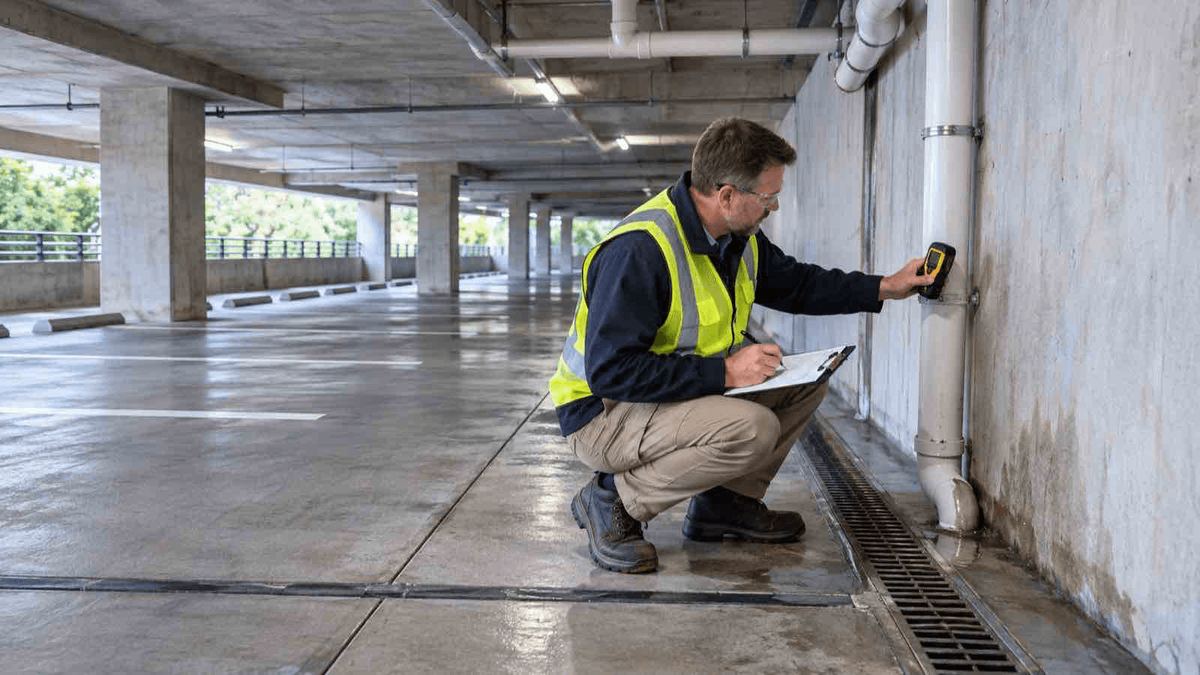
Parking garages need routine moisture checks because rain, snow, plumbing, drainage, and condensation can keep hidden building materials damp. The concrete parking deck may tolerate occasional water, but attached drywall, insulation, stored materials, wood, coatings, utility rooms, and occupied spaces can respond differently.
Property teams often think of a garage as an outdoor environment, even when it sits below apartments, offices, hotels, or retail space. Water can enter through vehicle ramps, expansion joints, wall cracks, floor drains, leaking pipes, planter areas, or failed seals. Air movement and temperature changes can also create condensation on cold piping or surfaces.
A practical prevention program focuses on finding sources, protecting people, documenting locations, correcting drainage or leaks, drying affected materials, and checking again. Staff should not be expected to diagnose every stain or perform work beyond their training. They should know what to observe, what to report, and when qualified help is needed.
Why Parking Garages Need a Moisture Routine
Garages combine water, vehicles, pollutants, structural elements, and mechanical systems in a space that may receive limited routine housekeeping. Tire spray can carry water far from the entrance. Snow and ice can melt after vehicles park. Floor drains and trench drains can clog with sediment, leaves, trash, or debris. A small low point can hold water long after the rest of the deck appears dry.
Below-grade walls may show seepage, efflorescence, staining, peeling coatings, or damp joints. These observations do not by themselves identify the source or prove that mold is present. They are evidence that the property team should record and investigate. A recurring wet location may relate to exterior drainage, groundwater, plumbing, waterproofing, or a building assembly that needs professional evaluation.
Utility and storage rooms deserve special attention. A garage may contain electrical rooms, telecom spaces, fire protection equipment, janitorial closets, elevator equipment areas, pipe chases, or maintenance storage. Some rooms contain paper-faced gypsum board, cardboard, ceiling tile, insulation, wood, or dust that can support growth when moisture persists.
Vehicle exhaust, fuel, cleaning products, electrical hazards, traffic, poor lighting, and confined or restricted areas can complicate a moisture inspection. Staff should follow site safety procedures and should not enter unsafe rooms, open electrical equipment, disturb suspect materials, or work in traffic paths without appropriate controls.
Building a Practical Inspection Route
Start with a simple map. Mark vehicle entrances, ramps, trench drains, floor drains, sumps, low points, expansion joints, exterior walls, pipe penetrations, stairs, elevators, utility rooms, storage areas, and locations with prior leaks. Add shutoffs, pump controls, emergency contacts, and areas where runoff from outside can enter.
Inspect during representative conditions when it is safe to do so. A dry-day walk shows staining, deposits, damaged coatings, and stored materials. A visit during or shortly after rain or snowmelt can reveal active pathways, ponding, drain performance, and splash. Compare observations rather than relying on one snapshot.
Look at drainage first. Check whether grates are clear, water flows toward the intended drain, sediment is accumulating, and pumps or alarms show an obvious problem. Do not remove covers, enter sumps, or service equipment unless staff are authorized and trained. Report standing water, backups, unusual odors, repeated pump cycling, or an alarm under the property's procedure.
Check walls, ceilings, and joints for new stains, dampness, peeling finishes, cracks, mineral deposits, dripping, or corrosion. Use consistent location names such as level, column line, parking space, room number, or nearby asset. An overview photograph plus a close detail can help the next person find the same point.
Review piping and mechanical areas. Condensation can occur on cold water, chilled water, or other cool surfaces when surrounding air is humid. Look for missing insulation, wet insulation jackets, corrosion, drips, stained supports, or damp materials below. A container placed under a recurring drip is not a long-term correction.
Check stored materials and housekeeping. Cardboard, paper, fabric, wood, ceiling tile, and unused furnishings should not sit directly on a damp floor or against a wet wall. Keep inspection access around drains and vulnerable surfaces. Remove trash and sediment through approved procedures so they do not block drainage or hide conditions.
If staff use a moisture meter, define its purpose and limitations. Readings vary by material, depth, salts, temperature, calibration, and technique. A meter can help compare locations or follow drying, but it does not prove that mold is present or absent. Record the instrument, material, location, time, and conditions.
Responding to Water and Damp Materials
Protect people first. Keep staff and occupants away from electrical hazards, unstable surfaces, vehicle paths, contaminated water, or areas with poor air quality. Follow emergency and traffic-control procedures. A parking garage response should not create a struck-by or electrical hazard while trying to document water.
Control the source as soon as authorized personnel can do so safely. Clear an approved drain obstruction, stop a plumbing leak, adjust an operating problem, or protect an opening under the property's procedure. Some sources require a plumber, waterproofing contractor, engineer, restoration professional, or other qualified specialist.
Document before cleanup removes all evidence, but do not delay urgent protection. Record the discovery time, location, weather, visible path, affected materials, photographs, notifications, immediate controls, work order, and follow-up date. Link repeat events to the same asset or location so patterns remain visible.
Drying decisions depend on the water source, material, duration, area, and building conditions. Remove standing water using safe methods, improve appropriate ventilation or dehumidification, and evaluate porous materials that became wet. Fans should not be used automatically if they could spread contamination, vehicle pollutants, or disturbed material.
EPA guidance emphasizes moisture control and prompt attention to wet or damp materials. Property staff should avoid making health guarantees or declaring a location mold-free based only on appearance, odor, or one reading. Escalate persistent moisture, suspected hidden growth, recurring leaks, or extensive affected materials under the property's plan.
Follow-up is essential. A drain may work after cleaning but clog again because of a broken grate or sediment source. A repaired pipe may stop dripping while insulation remains wet. Reinspect the source, adjacent materials, and the area below or behind the original finding before closing the work order.
Common Mistakes and Misconceptions
One misconception is that mold cannot be a concern because the garage is made of concrete. Concrete itself is only part of the environment. Dust, coatings, wall finishes, insulation, cardboard, wood, and adjacent rooms can remain damp and support growth.
Another mistake is treating white mineral deposits as a complete diagnosis. Efflorescence can indicate moisture movement through masonry or concrete, but staff should not use it alone to decide the source, severity, or presence of mold. Record it and investigate the moisture pathway.
Teams sometimes paint over staining before correcting the source or verifying that materials are dry. The stain may disappear while moisture continues behind the coating. Source control and appropriate drying should come before cosmetic repair.
Bleach is not a universal answer. Material, porosity, scope, ventilation, worker protection, and the cause of moisture all matter. Staff should use approved procedures and qualified support rather than applying a chemical to every discolored surface.
There is no single federal airborne mold threshold that proves every garage or attached room is safe or unsafe. EPA, OSHA, and CDC do not certify individual mold inspectors or endorse a particular course. State and local rules may apply to assessment, remediation, licensing, disclosure, or worker protection.
How Training Helps
Training helps maintenance, security, housekeeping, parking, and property-management staff use the same observation and reporting process. Employees can learn common moisture sources, safe boundaries, documentation basics, drying principles, and the conditions that require escalation.
Mold Awareness Training can fit employees who need to recognize and report conditions without performing assessment or remediation. Property Management Mold Training may be more relevant for managers and maintenance leads who coordinate work orders, vendors, occupant communication, prevention, and records.
The relevant moldtraining.us courses provide certificates of completion and do not guarantee licensure. A certificate supports a training record but does not authorize regulated work. Employers and individuals should check state and local requirements before assigning mold assessment, inspection, or remediation duties.
A useful exercise is a garage walk after simulated heavy rain. Ask staff to map the water path, identify traffic and electrical hazards, photograph the finding, create a work order, choose the escalation contact, and schedule a follow-up. The exercise tests the building's process without asking staff to make a mold diagnosis.
For teams that want a structured baseline, a moldtraining.us course can support the next training cycle. Pair the course with the property's map, drain-maintenance schedule, vendor contacts, emergency procedures, and documentation standards.
Frequently Asked Questions
Does standing water on concrete always mean mold will grow?
No. Mold growth depends on moisture, time, temperature, available organic material, and other conditions. Standing water is still a maintenance and safety concern and can wet dust, coatings, stored materials, walls, or adjacent assemblies. Correct the source and dry affected materials promptly.
Should staff test every stain in a parking garage?
Not necessarily. Start with moisture source, location, material, duration, and recurrence. Many situations can be managed by correcting water intrusion and evaluating affected materials. Qualified assessment may be appropriate when the source is unclear, growth is suspected, or the scope exceeds routine staff capability.
Can a musty odor prove that mold is present?
No. Odor is an observation, not a complete diagnosis. Record where and when it occurs, check for moisture and ventilation problems, and follow the property's escalation procedure.
Are garage floor drains part of mold prevention?
They can be. Clear, maintained drainage helps limit standing water, but drain work may involve traffic, contaminated water, chemicals, or confined-space hazards. Only authorized and trained workers should inspect or service components under the site's procedures.
Does completing a mold course make someone a licensed inspector?
No. Courses provide certificates of completion and do not guarantee licensure. Requirements vary by state and locality. Check the applicable government authority before offering or assigning regulated services.
What should a garage moisture record include?
Record the date and time, exact location, weather or snowmelt conditions, visible source or path, affected materials, photographs, safety controls, notifications, work order, repairs, drying steps, follow-up findings, and closure decision.
Conclusion
Parking garage mold prevention starts with moisture management, not with guessing from a stain. Map vulnerable locations, keep drainage and access clear, document recurring pathways, protect porous materials, correct sources, dry affected areas appropriately, and verify the repair.
Training gives property teams a consistent way to notice and communicate problems while respecting safety and professional boundaries. It cannot guarantee that mold will never occur, replace qualified evaluation, or override local requirements. It can help a building respond earlier and keep the history needed for better maintenance decisions.
Sources
United States Environmental Protection Agency, A Brief Guide to Mold, Moisture and Your Home - https://www.epa.gov/mold/brief-guide-mold-moisture-and-your-home
United States Environmental Protection Agency, Mold Remediation in Schools and Commercial Buildings Guide - https://www.epa.gov/mold/mold-remediation-schools-and-commercial-buildings-guide
United States Environmental Protection Agency, Moisture Control Guidance for Building Design Construction and Maintenance - https://www.epa.gov/indoor-air-quality-iaq/moisture-control-guidance-building-design-construction-and-maintenance
Centers for Disease Control and Prevention, Mold - https://www.cdc.gov/mold/about/index.html