
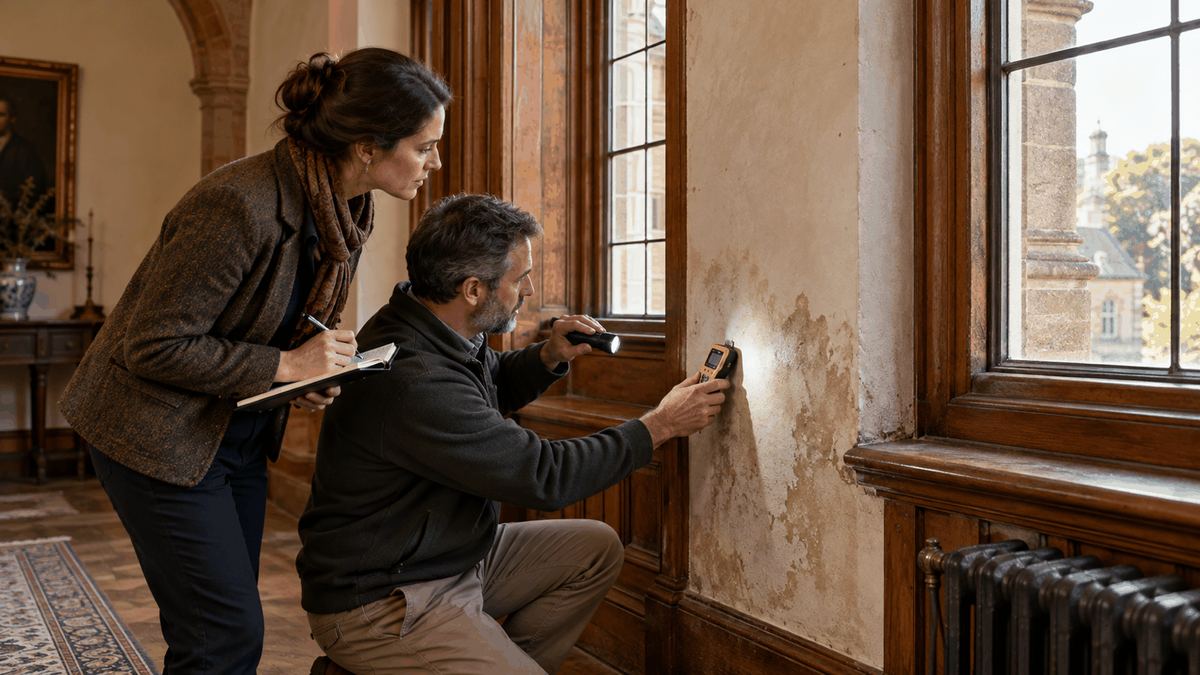
Historic properties need a moisture response that protects people and materials without hiding leaks, damaging finishes, or delaying needed repairs.
Older buildings can be durable, but their assemblies often behave differently from modern construction. Masonry walls may manage moisture through evaporation, wood windows may show condensation before mechanical sensors do, and roof, flashing, plumbing, drainage, or ventilation changes can create new wetting patterns. Property teams need a routine that observes those patterns without treating every stain as a reason for aggressive demolition.
Mold prevention starts with controlling moisture. In a historic property, that work also requires careful documentation, coordination with preservation personnel, and respect for materials that may be difficult to replace. Training helps staff recognize conditions early, make safe reports, and involve the right specialists before a small problem becomes a larger building and indoor air quality concern.
Why Historic Properties Need a Specific Moisture Routine
Historic buildings may contain thick masonry, lime plaster, old-growth wood, layered roofing, decorative finishes, concealed cavities, crawl spaces, and additions from several eras. A repair that works in a newer building can trap moisture or damage an older assembly. Staff should avoid assuming that a modern coating, sealant, or wall system is automatically compatible.
Water may enter through roofs, parapets, chimneys, cornices, windows, doors, foundation walls, and below-grade spaces. It may also come from plumbing, fire suppression, HVAC equipment, humidification, cleaning, or occupant activities. The visible spot can be far from the source because water travels along framing, pipes, masonry joints, or layered finishes.
Seasonal behavior matters. Wind-driven rain may wet one elevation, snow and ice can affect roofs and gutters, summer humidity can condense on cool surfaces, and winter indoor moisture can collect at windows or uninsulated corners. A useful inspection log connects observations to weather, occupancy, and building operation.
Historic significance does not make mold harmless, and mold concern does not justify uncontrolled disturbance. Property managers should address moisture promptly while considering occupant needs, suspect hazardous materials, fragile finishes, and preservation requirements. Qualified help may be needed to evaluate the source and plan compatible repairs.
Build a Moisture Map Before Problems Escalate
Start with a simple building map divided by floor, room, elevation, roof zone, and below-grade area. Mark prior leaks, plumbing chases, roof drains, gutters, downspouts, foundation transitions, mechanical rooms, bathrooms, kitchens, and spaces with limited airflow. Include closed rooms, attics, towers, crawl spaces, and storage areas that staff do not visit every day.
Assign a stable location name or number to each observation point. Descriptions such as north stair landing, west wall below window W-204 are more useful than upstairs stain. Repeatable locations help teams compare photographs and see whether the same condition returns after repair.
Record material as well as location. Plaster, wallpaper, wood flooring, masonry, insulation, carpet, and stored collections react differently to water. Note whether the surface is cold, damp, stained, blistered, soft, cracked, musty, or visibly affected. Do not diagnose a mold species by color or a photograph.
Pair routine walks with event-based checks. Inspect after major rain, roof or masonry work, plumbing repairs, HVAC shutdowns, freezing weather, sprinkler discharge, or a long vacancy. Check again after the initial repair because water can remain in concealed or slow-drying materials.
Use instruments within staff training and procedure. Moisture meters, humidity sensors, and infrared cameras can support investigation, but readings need context and suitable methods for the material. A number should not replace visual inspection, source control, or professional judgment.
A Careful Response to Water and Suspected Mold
First protect people and stop the source when staff can do so safely and within their authority. Control access around falling plaster, electrical hazards, contaminated water, structural damage, or extensive growth. Escalate emergencies and avoid disturbing suspect asbestos-containing materials, lead-based paint, or other hazardous building materials.
Document the initial condition before cleaning or opening assemblies. Capture the location, discovery time, weather, apparent source, materials affected, visible extent, odor, photographs, occupants or collections nearby, and immediate actions. Preserve enough context to help maintenance, preservation, insurance, and environmental professionals understand the event.
EPA recommends drying wet materials promptly, ideally within 24 to 48 hours, to reduce the opportunity for mold growth. That is a response goal, not a promise that every material can be saved or that mold will not occur. Thick masonry, plaster, wood, insulation, concealed cavities, and contaminated water may require a longer, professionally managed process.
Choose drying methods that do not damage historic materials or spread contamination. High heat, overly aggressive dehumidification, harsh chemicals, abrasive cleaning, and impermeable coatings can create additional problems. Coordinate methods with qualified preservation and remediation professionals when materials are significant, fragile, or unfamiliar.
Verify the repair and follow up. Record source correction, drying or removal decisions, environmental or preservation advice, cleaning, finish repairs, readings where appropriate, and a later inspection date. A closed ticket should show that the moisture source and affected materials were addressed, not only that the stain was painted.
Common Mistakes and Misconceptions
One mistake is sealing an old masonry wall as soon as a damp patch appears. An impermeable product may hide the symptom or reduce drying while the roof, flashing, drainage, or rising moisture problem continues. Diagnose the water path before choosing a treatment.
Another mistake is removing historic plaster or wood before documenting the condition and considering repair options. Some materials can be dried or repaired, while others cannot. The decision depends on contamination, deterioration, significance, access, cost, and professional evaluation.
Do not assume a musty odor identifies a specific mold or proves its location. Odor is a reason to look for moisture and possible hidden growth, but the source may be behind finishes, below flooring, inside a mechanical system, or among stored materials.
Do not rely on bleach or fragrance as a moisture solution. Products do not repair a leak, and inappropriate chemicals can harm finishes or create exposure. Cleaning methods should fit the surface, scope, occupancy, and applicable guidance.
Do not wait for visible mold before responding to water. Repeated condensation, damp plaster, peeling paint, efflorescence, swollen wood, or recurring roof stains can justify investigation even when growth is not obvious.
Do not use a single indoor humidity number as proof that the building is dry. Local cold surfaces, concealed leaks, wet masonry, and blocked drainage can create problems while a central sensor appears normal. Trends and location-specific observations are more useful.
How Training Helps
Training gives front-desk staff, guides, custodians, maintenance employees, property managers, and volunteers a shared reporting language. They can learn to distinguish observation from diagnosis, record useful details, and avoid actions that disturb materials or hide the source.
Role-based exercises can use realistic scenarios: a roof stain after wind-driven rain, condensation on a display case near an exterior wall, a plumbing leak above decorative plaster, or damp masonry in a basement archive. Teams should identify who controls the area, who stops the source, who documents the condition, and when preservation, environmental, plumbing, roofing, or structural help is needed.
Maintenance training should include safe access limits, moisture mapping, photo standards, work-order links, compatible temporary controls, and post-repair checks. Managers should understand vendor scopes, communication with occupants, and state or local rules that may apply to mold assessment or remediation.
The Mold Prevention and Remediation Awareness Training course at moldtraining.us can provide general moisture and mold awareness for property and facilities teams. The course provides a certificate of completion. It does not guarantee licensure or authorize regulated work, and participants and employers should review current state and local requirements.
Training should be reinforced with property-specific procedures. Include emergency contacts, restricted materials, preservation contacts, approved documentation locations, vendor arrangements, occupant communication, and decision points for professional evaluation. Review the procedure after a significant water event or a repair that does not hold.
Frequently Asked Questions
Should staff test every dark stain for mold?
Not necessarily. A dark stain can have several causes, and sampling is not a substitute for finding and correcting moisture. Staff should document the condition, inspect for a water source within their role, and use qualified professional advice when the extent, material, or health concern is uncertain.
Can historic plaster be saved after it gets wet?
Sometimes, but the answer depends on the water source, duration, contamination, attachment, cracking, salts, concealed materials, and significance. Prompt source control and evaluation improve the options. Avoid removing it automatically before the condition is documented and qualified people review it.
Is the 24 to 48 hour drying goal a guarantee against mold?
No. EPA uses prompt drying, ideally within 24 to 48 hours, as practical prevention guidance. It is not a guarantee. Thick, concealed, porous, or contaminated materials may need specialized evaluation and a longer controlled response.
Should windows be replaced if they collect condensation?
Condensation should prompt a review of indoor moisture, surface temperature, airflow, weather, and window condition. Replacement is only one possible response and may affect historic character. Maintenance, operational changes, repair, or compatible storm systems may also be considered with appropriate expertise.
Does a course certificate make someone a licensed mold inspector?
No. A certificate of completion documents that a person completed the course. It does not guarantee licensure, meet every jurisdiction's requirements, or replace experience, insurance, supervision, and property-specific procedures. Check state and local rules before offering regulated services.
When should a historic property call a specialist?
Seek qualified help when water is contaminated, damage is extensive or hidden, significant materials are involved, structural or electrical hazards exist, occupants report health concerns, suspect hazardous materials may be disturbed, or the source and scope remain unclear.
Conclusion
Historic properties benefit from a moisture program that is prompt, observant, and careful. Staff should know the building's recurring wet areas, report changes consistently, protect people and materials, and connect source repairs with drying verification and follow-up.
The goal is not to turn every employee into a mold inspector or preservation specialist. It is to give the property team enough awareness to recognize a developing issue, preserve useful evidence, avoid damaging shortcuts, and bring the right expertise into the decision at the right time.
Sources
United States Environmental Protection Agency, Biological Contaminants and Indoor Air Quality | https://www.epa.gov/indoor-air-quality-iaq/biological-contaminants-and-indoor-air-quality
United States Environmental Protection Agency, Mold Remediation in Schools and Commercial Buildings Guide | https://www.epa.gov/mold/mold-remediation-schools-and-commercial-buildings-guide
United States Environmental Protection Agency, Mold Course Chapter 2: Why and Where Mold Grows | https://www.epa.gov/mold/mold-course-chapter-2
Centers for Disease Control and Prevention, Mold | https://www.cdc.gov/mold-health/about/index.html