
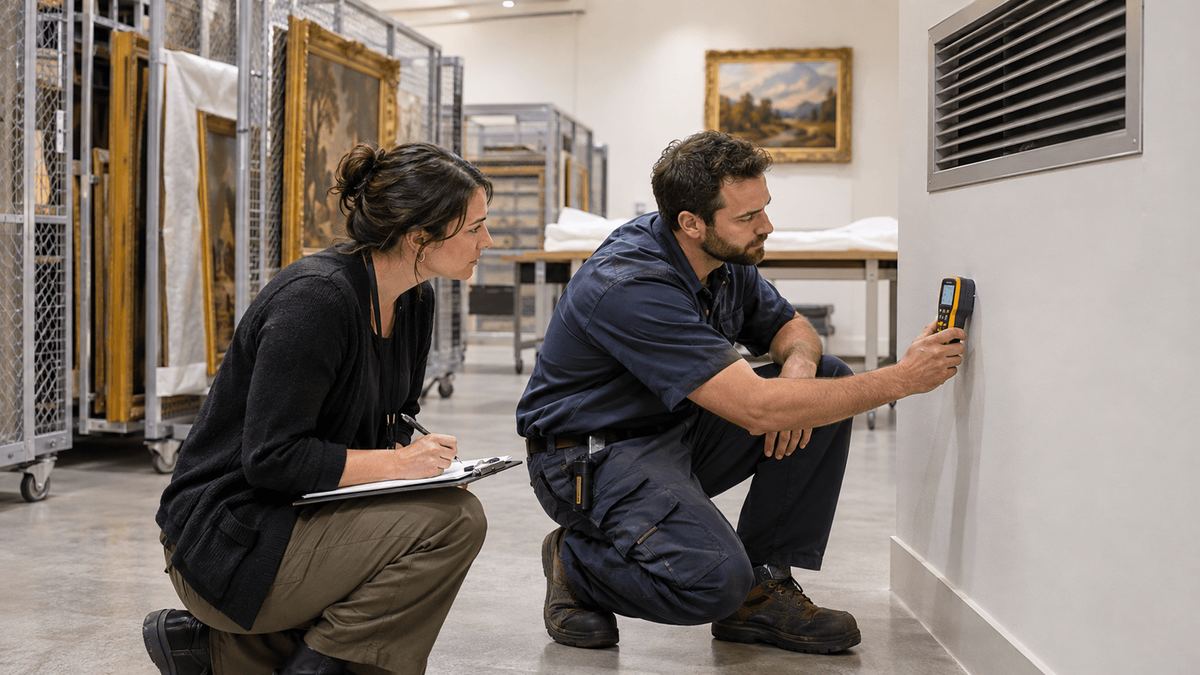
Museum and gallery teams need a moisture response plan that protects people, collections, and building materials without turning every concern into a crisis. The work is unusually sensitive because a slow roof leak, plumbing problem, condensation event, or unstable indoor condition can affect both ordinary construction materials and irreplaceable objects.
Facilities staff may be the first to see a ceiling stain, damp baseboard, musty odor, elevated humidity reading, or water near an exterior wall. Collections staff may notice a change inside a cabinet or behind a framed work before the building team sees a broader pattern. Security, housekeeping, installers, and visitor-services staff may observe a drip or odor during hours when maintenance personnel are elsewhere.
A practical program connects those observations to prompt reporting, source control, material protection, drying, documentation, and qualified support. It should not rely on staff guessing whether a condition is safe or attempting work outside their training. The objective is early, organized response that respects both building operations and collection-care priorities.
Moisture Risks Unique to Museums and Galleries
Collection spaces often use tight environmental controls, but controlled conditions do not eliminate moisture risk. HVAC failures, blocked condensate drains, leaking humidification equipment, roof and flashing defects, plumbing leaks, exterior drainage problems, and condensation on cool surfaces can introduce water. Temporary walls, crates, dense shelving, and display cases can conceal damp materials or limit airflow.
Older museums may contain masonry, plaster, wood, and building assemblies that behave differently from newer finishes. Galleries in converted warehouses, storefronts, houses, and civic buildings may have mixed insulation, intermittent conditioning, or complex rooflines. A repair method that is routine in a modern office may not be appropriate for historic fabric or sensitive collections.
The response plan should distinguish the building moisture problem from collection treatment. Facilities personnel can stop a leak, isolate an area, and coordinate drying, while a conservator or collections professional determines how objects should be handled. Mold growth on an artifact, archival material, or valuable frame can require specialized expertise that differs from remediation of drywall or carpet.
Building a Practical Moisture Check Routine
Start with a shared map of vulnerable locations. Include roof drains, skylights, exterior walls, windows, loading areas, below-grade rooms, restrooms, kitchens, mechanical rooms, condensate lines, humidification equipment, collection storage, exhibit cases, and spaces with a history of water intrusion. Add shutoffs, floor drains, moisture-response supplies, and after-hours contacts.
Routine checks should combine visual observation with operational context. Look for staining, bubbling paint, warped finishes, efflorescence, damp dust, rust, peeling sealant, wet ceiling tiles, standing water, and unexpected odors. Ask whether recent weather, maintenance, construction, or HVAC alarms could explain the condition. A single reading can be useful, but trends and the location of the moisture source are often more informative.
When staff use moisture meters or data loggers, the organization should define what the equipment can and cannot show. Meter readings may vary with material, calibration, temperature, salts, depth, and technique. Data loggers can identify changing temperature or relative humidity, but they do not by themselves locate a leak or determine whether hidden mold is present. Train staff to record the instrument, location, material, time, and relevant conditions.
Housekeeping can support early detection. Staff who clean floors, cases, storage aisles, and mechanical spaces often visit locations more frequently than managers. Give them a simple reporting path for water, odors, stains, blocked vents, damaged seals, or unusual condensation. Reporting should not require them to diagnose the cause.
Storage and display practices can reduce exposure. Keep collections and packing materials off floors where practical, maintain inspection access along vulnerable walls, avoid blocking vents, and use appropriate protective coverings during work. Do not wrap damp objects or wet building materials in impermeable plastic without direction, because trapped moisture can create additional problems.
Responding to a Water Event
Life safety comes first. Staff should not enter areas with electrical hazards, contaminated water, unstable materials, or other unsafe conditions. Follow emergency procedures, isolate the area, and involve qualified responders when the source or environment is beyond routine maintenance capability.
Stop or control the moisture source as soon as it can be done safely. Shut off water, protect the roof opening, clear a blocked drain, or disable failed equipment through authorized personnel. Move unaffected collections away from the pathway if the collections plan allows and if handling will not create more damage. Coordinate object movement with collections staff so location and custody records remain accurate.
Document the event before cleanup erases useful evidence, but do not delay urgent protection. Record the time discovered, source if known, affected rooms, visible water path, materials involved, environmental readings, photographs, notifications, and immediate actions. Use consistent location names. An overview photograph and a close detail are often more useful than several images with no context.
Drying decisions should consider both the building and the collection. Remove standing water, promote appropriate air movement, and monitor conditions under the response plan. Some materials can be dried in place, while others may need removal or specialist handling. Fans should not be used casually where they could spread contamination or disturb fragile objects.
EPA guidance emphasizes moisture control as the key to mold control and notes that wet or damp materials and areas should be dried promptly. The exact response depends on the size, material, water source, time, and occupancy. Property staff should not make health guarantees or declare an area mold-free based only on appearance or odor.
Common Mistakes and Misconceptions
One misconception is that a museum with strict humidity control cannot have a mold problem. Controls reduce risk only when equipment, drainage, sensors, envelopes, and operating procedures work as intended. Localized condensation can occur even when a central reading looks normal.
Another mistake is treating every musty odor as proof of visible mold or ignoring it because no growth is seen. Odor is an observation that deserves investigation, not a complete diagnosis. Staff should record where and when it occurs, check for moisture sources, and escalate according to the plan.
Teams sometimes focus on protecting artwork while overlooking wet building materials behind it. A leak can continue inside a wall, ceiling, or case even after the object has been moved. Source correction, drying, and follow-up checks should cover the entire affected assembly.
Bleach is not a universal solution. Material type, porosity, surface condition, collection sensitivity, and the scope of contamination matter. Staff should not apply cleaners or biocides to artwork, archival materials, historic finishes, or building materials without an approved procedure and appropriate expertise.
There is also no single federal airborne mold threshold that proves every museum space is safe or unsafe. EPA, OSHA, and CDC do not certify individual mold inspectors or endorse a particular course. State and local rules may apply to assessment, remediation, licensing, disclosures, or worker protection, so organizations should verify requirements for their jurisdiction.
How Training Helps
Training gives teams a common vocabulary for moisture sources, observations, documentation, prevention, and escalation. General staff may need Mold Awareness Training so they can recognize conditions and report them promptly. Facility managers, maintenance leads, operations staff, and property professionals who coordinate work orders and vendors may find Property Management Mold Training more relevant.
The course should be paired with museum-specific procedures. Staff still need instruction on collection priorities, emergency contacts, object handling restrictions, HVAC controls, electrical safety, contaminated water, approved vendors, and communication with leadership. A classroom example cannot replace the institution's collection emergency plan or the judgment of conservators and qualified professionals.
Moldtraining.us courses provide certificates of completion and do not guarantee licensure. A certificate can support the training record, but it does not authorize a person to perform regulated assessment or remediation work. Employers and individuals should check state and local requirements before assigning those duties.
A useful exercise is a tabletop scenario involving a small overnight roof leak above an exhibit preparation room. Ask who receives the alarm, protects nearby objects, documents the water path, selects drying steps, calls specialists, and verifies follow-up. The unanswered questions reveal where the procedure needs work.
For teams that want a structured baseline, reviewing the relevant moldtraining.us course can be a practical next step. Use the course concepts to improve the institution's own checklist and handoffs rather than treating completion as the end of preparation.
Frequently Asked Questions
Should staff move collections as soon as water is discovered?
Only when it can be done safely and under the institution's collection emergency procedure. Moving an object can cause damage, disrupt records, or expose staff to hazards. Coordinate with collections personnel and stabilize the source and area as priorities allow.
Can a moisture meter confirm that mold is absent?
No. A moisture meter can support an investigation by comparing readings in specific materials, but it does not prove that mold is present or absent. Technique, material, calibration, and conditions affect results. Use readings with visual observations, source information, and qualified evaluation when needed.
Is a brief humidity increase always an emergency?
Not necessarily. The significance depends on the level, duration, materials, location, and cause. A short change may call for monitoring, while persistent high humidity, condensation, or wet materials may require prompt action. Follow collection and facility thresholds established by the institution's qualified staff.
Who should handle mold found on an artifact?
The institution should involve a conservator or other qualified collection-care professional. Cleaning an artifact is not the same as cleaning ordinary building material, and an incorrect method can permanently damage the object or spread contamination.
Does a mold course make an employee a licensed inspector?
No. Courses provide certificates of completion and do not guarantee licensure. Inspection, assessment, or remediation requirements vary by state and locality. Direct staff to the applicable government authority and the organization's legal or risk advisers for jurisdiction-specific requirements.
What records should the museum keep after a leak?
Keep the discovery time, source, affected locations and materials, photographs, readings, notifications, object movements, drying or repair steps, vendor reports, follow-up checks, and closure decision. Retention should match the institution's policies, insurance needs, collection records, and applicable requirements.
Conclusion
Museums and galleries can improve mold prevention by treating moisture response as a coordinated building and collection-care process. Map vulnerable areas, create easy reporting channels, document water events, control sources, dry affected materials appropriately, and involve specialists when the condition exceeds routine staff capability.
Training supports that process when it is matched to roles and reinforced with site procedures. It cannot guarantee that mold will not occur, and it does not replace professional judgment or local requirements. It can help staff notice problems earlier, communicate clearly, and protect collections while the organization makes informed response decisions.
Sources
United States Environmental Protection Agency, Mold Course Introduction - https://www.epa.gov/mold/mold-course-introduction
United States Environmental Protection Agency, A Brief Guide to Mold, Moisture and Your Home - https://www.epa.gov/mold/brief-guide-mold-moisture-and-your-home
United States Environmental Protection Agency, Mold Remediation in Schools and Commercial Buildings Guide - https://www.epa.gov/mold/mold-remediation-schools-and-commercial-buildings-guide
Centers for Disease Control and Prevention, Mold - https://www.cdc.gov/mold/about/index.html