
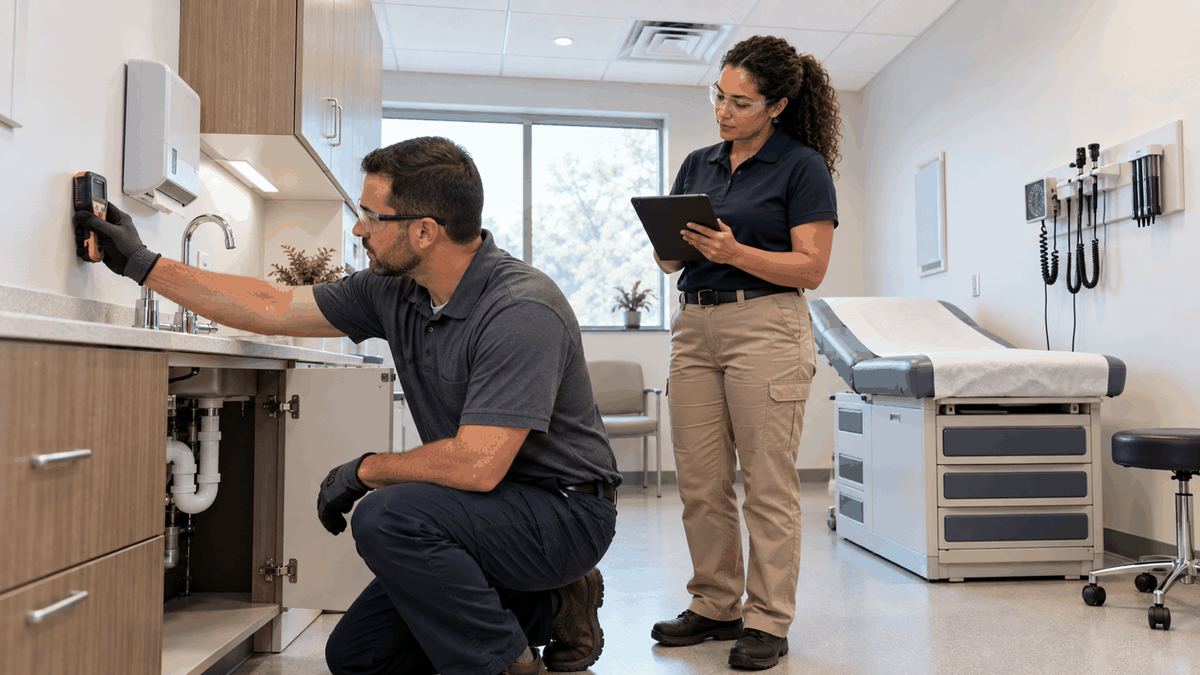
Medical clinics need a moisture response routine that protects occupied rooms, documents hidden damp areas, and coordinates repairs around patient care. A small supply-line seep under an exam-room sink, condensation above a ceiling tile, or a slow drain-pan overflow can damp porous materials before stains become obvious. Facilities teams that know where to look and how to hand off findings can address the water source earlier and reduce the chance that a limited repair becomes a larger building problem.
Mold prevention in a clinic begins with moisture control, not with identifying a particular mold species. EPA guidance for commercial buildings emphasizes finding and correcting water or humidity problems, drying wet materials promptly, and adjusting the response when hidden damage is discovered. CDC and NIOSH also note that indoor mold indicates a water or moisture problem and that routine air sampling is generally not recommended for building evaluations.
Clinic property teams should coordinate facility procedures with infection prevention, environmental services, clinical leadership, safety staff, and qualified outside professionals as appropriate. This article discusses building moisture and mold prevention. It does not provide medical advice, diagnose occupant symptoms, or replace healthcare-specific infection control, construction, ventilation, licensing, or accreditation requirements.
Who This Affects
Facility managers and building engineers usually own the technical response. They inspect plumbing, HVAC equipment, roof and envelope conditions, ceiling spaces, and building controls. They also decide when a room should be taken out of service, when materials can be dried, and when an experienced consultant or remediation contractor is needed. Their records should connect the first report to the water-source repair and final verification.
Clinic managers and practice administrators coordinate operational effects. They may need to relocate appointments, control access, notify a landlord, approve after-hours work, or preserve privacy while contractors enter clinical areas. A prepared decision tree helps them act without asking maintenance staff to make clinical or administrative decisions outside their role.
Environmental services staff often notice early clues during cleaning. Repeated dampness around a sink base, discolored ceiling tile, musty odor, lifting flooring, or recurring condensation may appear between formal inspections. Training can help these employees report observable conditions accurately without diagnosing mold or applying a quick cosmetic treatment that hides the source.
Where Clinic Moisture Problems Often Start
Exam-room sinks deserve routine attention. Check supply connections, valves, drains, traps, sealant joints, cabinet bases, and the wall-floor intersection. A cabinet can conceal slow leakage, and stored supplies can absorb water before it reaches the floor. Keep the cabinet organized enough that staff can see plumbing and inspect the base without moving sensitive materials.
Sterilization, laboratory, medication preparation, and utility areas may combine sinks, equipment, drains, and frequent cleaning. Teams should follow the equipment manufacturer's maintenance instructions and clinic procedures while watching for leaking hoses, clogged drains, damaged sealant, and condensation on cold surfaces. Water associated with a process or potentially contaminated source calls for a response appropriate to that source, not a generic clean-water assumption.
Ceiling cavities can hide roof, condensate, sprinkler, and plumbing leaks. A stained tile is a sign to investigate above, not simply replace the visible tile. Teams should identify the source, inspect nearby materials, and review what is located below the leak. Opening a ceiling in an occupied clinic can create dust and other concerns, so facilities staff should coordinate access and containment with the clinic's applicable procedures.
HVAC systems can contribute moisture through clogged condensate drains, wet insulation, uncontrolled humidity, short cycling, poor air balance, or condensation on cold ducts and diffusers. EPA advises against running an HVAC system known or suspected to be contaminated with mold. Facility teams should avoid broad conclusions based on a dirty grille alone and use qualified HVAC or indoor environmental support when system contamination is suspected.
Exterior walls, windows, roof transitions, and utility penetrations can admit rain. Look for bubbling finishes, soft wallboard, damaged sealants, wet insulation, or recurring staining after particular wind and rain conditions. A leak that disappears in dry weather still needs a repair record and follow-up under similar weather when practical.
A Practical Moisture Response Routine
Start by recording the date, time, room, exact location, observed water source, visible material changes, odor if present, and any immediate operational concern. Photographs should avoid patient information, clinical records, or identifiable people. Use neutral descriptions such as "wet ceiling tile near supply diffuser" rather than a diagnosis such as "toxic mold."
Stop or control the water source when staff can do so safely and within their authorization. Protect people and equipment from electrical, slip, ceiling-collapse, and contamination hazards. If the source is unknown, extensive, or potentially contaminated, isolate the area under the clinic's procedures and contact qualified help.
Assess more than the visible surface. Water can move behind base, under resilient flooring, above ceilings, and through wall cavities. A moisture meter can support comparison when used by a trained person who understands the material and instrument limitations. Readings should be interpreted with visual observations, known dry references, and the repair history rather than treated as a stand-alone verdict.
Plan drying and material decisions based on the water source, materials affected, elapsed time, and applicable guidance. EPA commonly recommends drying wet or damp materials promptly, often within 24 to 48 hours, while noting that mold growth is not guaranteed or excluded by a clock. Porous materials that cannot be cleaned and dried may need replacement. Hidden or larger problems may require professional evaluation and a revised plan.
Coordinate the work area with clinic operations. Decide whether the room can remain in service, how access will be controlled, when noisy or dusty work will occur, and how clean and dirty pathways will be managed under clinic requirements. Moisture response and infection prevention serve different purposes, but the work plans must not conflict.
Close the record only after the source repair, drying or material action, cleaning, and follow-up check are documented. Record who verified the work and when. A brief reinspection after the room returns to normal use can catch recurring leaks or condensation that were not apparent during the initial repair.
Common Mistakes and Misconceptions
One mistake is replacing a stained ceiling tile without finding the source. The new tile may hide a continuing roof, pipe, or condensate leak.
Another is assuming that bleach, fragrance, or paint solves a moisture problem. Surface appearance is secondary to correcting the water source and deciding how affected materials should be cleaned, dried, or removed.
Teams may also treat one humidity reading as a complete investigation. Relative humidity changes with temperature, location, time, occupancy, and HVAC operation. Trends and surface conditions provide more context than a single reading.
Routine air sampling is often mistaken for a universal clearance tool. CDC and NIOSH state that there are no health-based indoor-air standards for mold and do not recommend routine air sampling in building air-quality evaluations. A qualified professional may recommend testing for a specific purpose, but the question and interpretation should be clear before samples are collected.
The phrase "toxic mold" can create unnecessary alarm. CDC explains that molds capable of producing mycotoxins should be treated like other indoor molds: the building moisture problem should be addressed. Staff should communicate observed conditions and next steps without assigning health conclusions.
Finally, clinic teams should not assume that ordinary maintenance staff are prepared for every remediation. Extent, hidden growth, contaminated water, HVAC involvement, sensitive occupants, and applicable clinic procedures may justify outside expertise and more protective controls.
How Training Helps
Training gives staff a common vocabulary for water sources, damp materials, condensation, visible growth, musty odors, and response records. It helps environmental services, facilities, and administrators send consistent information through the same escalation path.
The Property Management Mold Training course from moldtraining.us is a natural fit for facility managers, maintenance leads, and property teams who coordinate moisture prevention, documentation, and vendor handoffs. The Mold Awareness Training course can support general staff who need to recognize and report conditions without performing inspections or remediation. Employers should add clinic-specific procedures, hands-on instruction, and role assignments.
These courses provide certificates of completion. A certificate documents training; it does not guarantee licensure or authorize work that state or local rules reserve for licensed professionals. Requirements differ by jurisdiction, so learners and employers should check current state and local requirements before offering mold assessment or remediation services.
A soft next step is to compare the moldtraining.us course descriptions with each employee's actual responsibilities. Choose awareness-level education for people who mainly report conditions and property-management training for people who coordinate prevention and response. More specialized inspection or remediation duties may require additional education, experience, supervision, or licensing.
Frequently Asked Questions
Should a clinic close a room whenever moisture is found?
Not automatically. The decision depends on the source, extent, materials, hazards, work required, and clinic procedures. Facilities and clinical leadership should coordinate the decision, and qualified health, safety, infection prevention, or environmental professionals should be involved when appropriate.
Is there a federal indoor mold exposure limit?
CDC and NIOSH state that there are no health-based indoor-air standards for mold or other biological agents. Teams should not invent a universal safe spore count. Focus on correcting moisture, evaluating visible or suspected damage, and following applicable professional and jurisdictional requirements.
Does a moisture meter prove that mold is present?
No. A moisture meter helps identify or compare damp materials when used correctly. It does not identify mold, determine a health risk, or replace inspection of the source and affected assembly.
Can clinic staff clean a small visible area themselves?
That depends on the water source, material, extent, staff training, occupant considerations, and clinic procedures. EPA provides general commercial-building guidance, but professional judgment is important. Potentially contaminated water, HVAC involvement, hidden growth, or a larger affected area can require a more cautious plan and experienced help.
Will a mold course make someone a licensed inspector or remediator?
No. Moldtraining.us courses provide certificates of completion and do not guarantee licensure. States and local jurisdictions may regulate mold assessment or remediation, so employers and learners should verify the rules where the work will occur.
Conclusion
Medical clinics can prevent many mold-related building problems by treating every leak, wet material, and condensation pattern as a moisture-control task with a clear owner. Routine checks around sinks, ceiling spaces, exterior transitions, and HVAC equipment help teams find conditions before they spread through concealed materials.
The strongest routine is simple: report observable facts, control the source, protect the area, evaluate hidden moisture, coordinate clinic operations, document drying and repairs, and verify that the problem does not return. Training supports that routine by clarifying roles and communication, while qualified professionals and state or local requirements guide work that exceeds the team's scope.
Sources
United States Environmental Protection Agency, Mold Remediation in Schools and Commercial Buildings Guide, Chapter 3: https://www.epa.gov/mold/mold-remediation-schools-and-commercial-buildings-guide-chapter-3
United States Environmental Protection Agency, Mold Remediation in Schools and Commercial Buildings Guide, Chapter 4: https://www.epa.gov/mold/mold-remediation-schools-and-commercial-buildings-guide-chapter-4
United States Environmental Protection Agency, Biological Contaminants and Indoor Air Quality: https://www.epa.gov/indoor-air-quality-iaq/biological-contaminants-and-indoor-air-quality
Centers for Disease Control and Prevention, NIOSH Mold, Testing, and Remediation: https://www.cdc.gov/niosh/mold/testing-remediation/index.html
Centers for Disease Control and Prevention, NIOSH Dampness and Mold Assessment Tool: https://www.cdc.gov/niosh/docs/2019-114/