
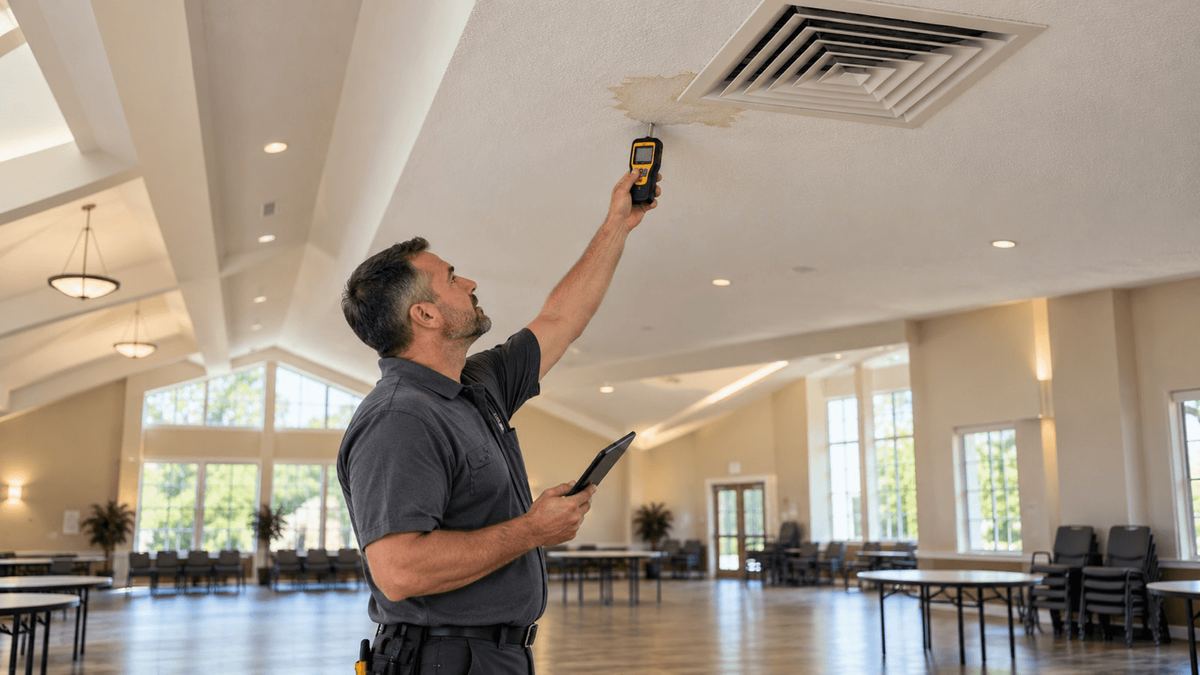
Places of worship can hide moisture between weekly gatherings, so facility teams need routine checks connecting roof, basement, plumbing, and HVAC clues. A quiet building may appear dry during an event while a roof penetration leaks above a ceiling, a basement wall stays damp, or an air-conditioning drain overflows into a closed room.
The goal is not to turn clergy, volunteers, custodians, or property committee members into mold assessors. It is to help the people who know the building recognize moisture indicators, report them consistently, protect occupants and materials, and bring in qualified help when the condition exceeds their role.
Why Places of Worship Need a Moisture Routine
Many worship facilities combine spaces built in different decades. A sanctuary, fellowship hall, classroom wing, kitchen, office, storage room, and mechanical area may have different roofs, foundations, plumbing systems, and ventilation patterns. Additions can create concealed valleys, wall joints, and drainage changes that deserve special attention after storms.
Occupancy is also uneven. A building may be crowded for services, classes, meals, or community programs and nearly empty on other days. HVAC schedules may change with events. Doors may open frequently during a gathering and remain closed for long periods afterward. These patterns can affect humidity, condensation, and how quickly a problem is noticed.
Responsibility may be shared among an employee, a volunteer property committee, custodial staff, outside contractors, and organizational leaders. Without a clear process, one person may notice a stain, another may arrange a repair, and nobody may verify whether wet materials dried or whether the same area became damp again.
EPA guidance for schools and commercial buildings emphasizes moisture control as central to mold prevention. Roof leaks, drainage that directs water toward a building, delayed maintenance, and high humidity can contribute to moisture problems. The practical response is to find and correct the water source, evaluate affected materials, dry appropriate materials, document what happened, and check for recurrence.
A Building-Specific Inspection Route
Start outdoors. Review roof drainage from a safe location, including gutters, downspouts, scuppers, roof drains, splash blocks, and discharge points. Look for overflow staining, erosion, standing water, damaged sealant, and landscaping that holds water near the foundation. Roof access should be limited to trained and authorized people using appropriate fall-protection procedures.
Inside, inspect ceilings and upper walls below roof penetrations, valleys, parapets, drains, and mechanical equipment. Water may travel along framing before appearing, so a stain does not always identify the source directly above it. Record its exact location, size, color, surface condition, and whether it is damp now. Compare with earlier photographs or work orders.
Basements and lower levels deserve a separate route. Check foundation walls, floor joints, sump systems, drains, stored materials, utility penetrations, and areas below kitchens or restrooms. Note efflorescence, peeling finishes, wet carpet, warped baseboards, rust, musty odor, or items stored directly against damp walls. Cardboard, fabric, books, and event supplies can conceal a developing condition.
HVAC checks should stay within the person's training and authorization. Staff can observe accessible drain pans, condensate lines, insulation, filters, supply areas, and nearby finishes without opening energized equipment or disturbing suspect material. Recurring condensation, water below an air handler, wet insulation, or a blocked drain should enter the maintenance process promptly.
Kitchens, restrooms, baptismal areas, nurseries, and janitorial rooms add plumbing and humidity sources. Check below sinks, around toilet bases, at floor drains, behind accessible appliances, and near supply connections. After large events, note condensation, spills, or ventilation problems rather than waiting for the next scheduled building round.
Use an event-driven check after heavy rain, wind-driven rain, freezing conditions, a plumbing repair, roof work, HVAC shutdown, power outage, or report of an odor. The route should reflect the building's known history. If the west wall has leaked three times, it deserves a defined inspection point rather than another informal reminder.
Common Mistakes and Misconceptions
A common misconception is that a dry surface proves the assembly is dry. Ceiling tile, drywall, insulation, carpet, and wood can hold or conceal moisture. A visual inspection is useful, but uncertain or extensive conditions may require qualified assessment and appropriate instruments.
Another mistake is painting over a stain before the source and material condition are understood. New paint can hide the history without correcting the leak. Closeout should address the source, affected materials, drying or removal decisions, repair, and follow-up.
People also assume that a musty odor identifies a specific material or health risk. Odor is a reason to investigate, not a diagnosis. Staff should record when and where it occurs, nearby moisture sources, HVAC operation, and weather conditions. They should avoid making medical claims to occupants.
It is a mistake to disturb suspect growth without considering scope, material, occupants, and containment. Brushing, sanding, opening a wall, or running air-moving equipment can spread dust or contamination. Large, hidden, recurring, or complex conditions should be evaluated by qualified professionals consistent with applicable requirements.
Another misconception is that bleach or fragrance resolves every problem. Products do not replace moisture-source correction, appropriate cleaning or removal, drying, and verification. Staff should follow product labels, employer procedures, and professional recommendations rather than improvising chemical treatment.
Finally, volunteer status does not make hazards disappear. People performing maintenance need clear limits, safe access, personal protective equipment where appropriate, and direction about when to stop. The organization should not ask an untrained volunteer to enter a confined area, work at height, open electrical equipment, or disturb suspect hazardous material.
How Training Helps
Training gives staff and volunteers a shared vocabulary for moisture, visible growth, condensation, water damage, and escalation. A consistent report can identify the room, surface, first observation, current wetness, odor, weather, nearby plumbing or HVAC, photographs, temporary controls, and person notified. That record is more useful than a message saying there may be mold somewhere downstairs.
Training can also define roles. An usher may report a ceiling drip and keep people away from a wet floor. A facilities employee may shut off water if authorized, inspect adjacent accessible areas, and start the work order. A property committee may approve a vendor. A qualified professional may assess hidden or extensive conditions. Leaders may coordinate communication and scheduling.
The Mold Awareness, Prevention and Remediation Training for Property Management Teams at moldtraining.us is a natural fit for employees and property leaders who manage moisture reports, maintenance coordination, and documentation. The Mold Prevention and Remediation Awareness course may fit workers or volunteers who need a narrower foundation for recognition and reporting.
These courses provide certificates of completion. They do not guarantee licensure, authorization to perform regulated work, or acceptance by an employer or agency. Mold assessment, remediation, contracting, disclosure, and licensing requirements vary, so learners and organizations should check current state and local requirements before assigning specialized work.
General instruction should be paired with the facility's inspection route, roof-access rules, emergency contacts, vendor list, work-order process, occupant communication plan, and hands-on instruction for any instrument employees are expected to use. Training supports better decisions, but the organization remains responsible for the building and its procedures.
A Practical Moisture Response Workflow
First, record and control. Document the location and time, stop an active source if authorized and safe, protect people from slip, electrical, ceiling, or falling-material hazards, and isolate the area when needed. Do not promise a cause before investigation.
Second, inspect the surrounding pattern. Check adjacent rooms, the floor above and below, exterior conditions, plumbing routes, roof features, and HVAC operation. Ask whether the condition follows rain, a particular event, cleaning, equipment operation, or a recent repair.
Third, decide who is qualified for the next step. A routine plumbing repair may be clear, while hidden damage, widespread growth, sensitive occupancy, recurring water, or uncertain source may call for specialized assessment. Confirm state and local requirements before selecting or assigning regulated services.
Fourth, document drying, removal, repair, and disposal decisions. Record vendor work, dates, affected materials, photographs, and any access restrictions. Avoid declaring a space safe based only on appearance or a single moisture reading.
Fifth, verify closure. Reinspect after the repair and again after the next relevant weather or operating condition. Confirm that staining, odor, dampness, or condensation has not returned. A closed invoice is not the same as a verified moisture correction.
Frequently Asked Questions
Does a ceiling stain mean mold is present?
Not necessarily. A stain shows that moisture or another material affected the surface at some point. Staff should investigate the source, current moisture, affected materials, and nearby areas without assuming the presence or absence of mold from color alone.
Can volunteers perform mold cleanup?
That depends on the condition, task, training, hazards, organizational policy, and state or local requirements. Volunteers should not be assigned work beyond their competence or asked to disturb extensive, hidden, or uncertain conditions. Qualified professional help may be appropriate.
Is there a federal safe mold level for every building?
No universal federal indoor mold threshold applies to every building and situation. Moisture, visible growth, odor, material damage, occupancy, and applicable guidance should inform the response. Avoid promising that one sample result proves a building is safe.
How quickly should wet materials be addressed?
Prompt action matters. EPA guidance commonly advises drying wet non-moldy materials quickly, often within 24 to 48 hours when feasible, while correcting the water source. Material type, contamination, extent, and site conditions affect the appropriate response.
Does a course certificate make someone licensed?
No. Moldtraining.us courses provide certificates of completion and do not guarantee licensure. Individuals and organizations should check current state and local rules and match training, supervision, and professional services to the work.
Conclusion
Places of worship benefit from a moisture program that fits their mixed-age buildings, intermittent occupancy, shared responsibilities, and community use. A short, repeatable route through roofs, ceilings, basements, plumbing areas, and HVAC surroundings can turn scattered observations into timely maintenance.
Use training to build recognition and reporting, then support it with clear limits, qualified vendors, local-requirement checks, and follow-up after repairs. A soft starting point is the property-management team course at moldtraining.us, paired with a site walk that turns the lessons into a building-specific routine.
Sources
United States Environmental Protection Agency, Mold and Moisture, https://www.epa.gov/mold
United States Environmental Protection Agency, Mold Remediation in Schools and Commercial Buildings Guide Chapter 1, https://www.epa.gov/mold/mold-remediation-schools-and-commercial-buildings-guide-chapter-1
United States Environmental Protection Agency, Mold Remediation in Schools and Commercial Buildings Guide Chapter 3, https://www.epa.gov/mold/mold-remediation-schools-and-commercial-buildings-guide-chapter-3
Centers for Disease Control and Prevention, Mold, https://www.cdc.gov/mold-health/about/index.html