
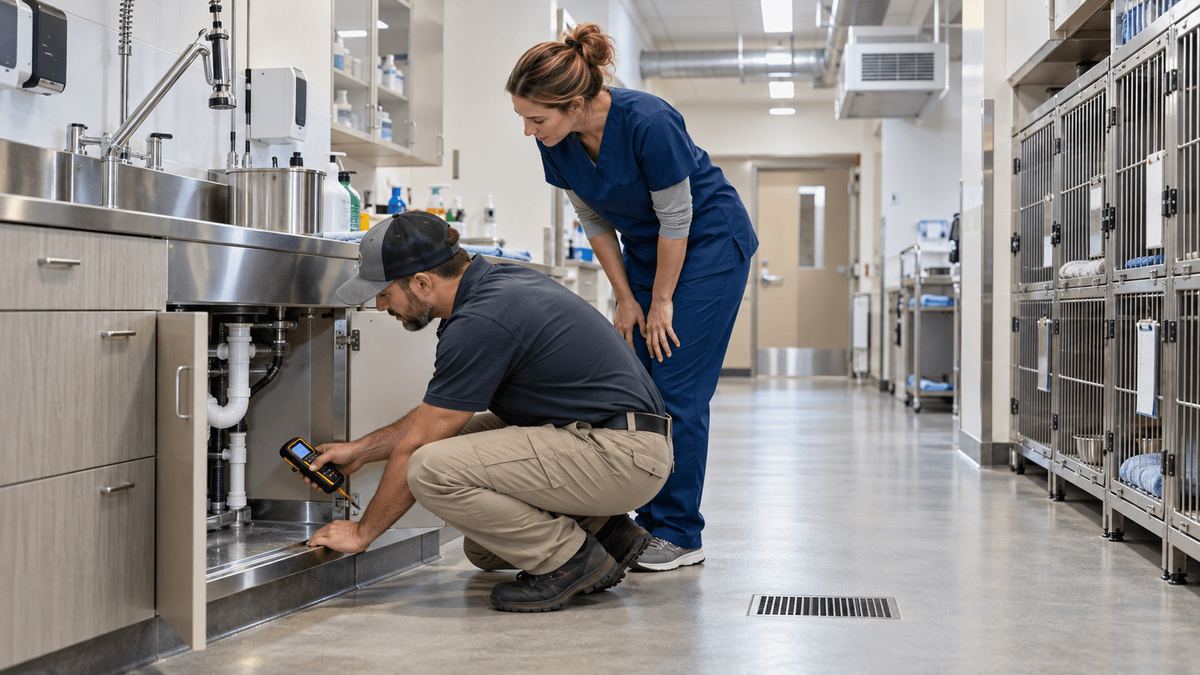
Veterinary clinics combine frequent washing, plumbing, animal-care equipment, and changing indoor loads, so small moisture problems can spread unnoticed.
Treatment rooms, kennel runs, grooming or wash areas, laundry spaces, isolation rooms, pharmacy storage, and mechanical systems each create different moisture patterns. Water belongs in many clinic processes, but it should not remain in porous finishes, wall cavities, cabinets, flooring seams, or HVAC components. A practical prevention routine helps staff distinguish normal cleaning moisture from conditions that require maintenance follow-up.
Mold prevention begins with moisture control. EPA explains that mold can grow on many organic materials when moisture and oxygen are present, and CDC advises fixing moisture problems when mold is found. A clinic does not need a universal federal mold threshold to act on a leaking sink, repeated condensation, damp drywall, or a musty odor. There is no federal numerical mold limit that makes a building safe or unsafe in every situation.
Why Veterinary Clinics Need a Moisture Routine
Veterinary facilities operate through long days, changing occupancy, animal bathing, floor cleaning, laundry, sterilization, refrigeration, and HVAC cycles. Water can move from a routine source into a hidden assembly. A slow supply leak beneath a wash station may wet the cabinet base. Repeated spray can enter a failed seal at the floor and wall. Condensation can form on cold piping above a ceiling or behind equipment.
The building may include newer clinical finishes beside older construction. Stainless equipment and washable wall panels can make a room look dry even when moisture has migrated behind them. Kennel runs may have drains and sloped floors, but blocked drains, deteriorated grout, failed sealant, or poor drying can leave water at transitions. Laundry exhaust and humid air can affect nearby rooms if ventilation is not working as intended.
Moisture response should fit infection-control, occupational-safety, animal-welfare, and clinical operations. Employees should not open contaminated cavities, disturb suspect materials, or use chemicals in occupied animal areas without appropriate procedures. Building maintenance and mold awareness do not replace veterinary infection-control decisions or professional remediation when the situation exceeds staff capability.
Where Moisture Problems Often Begin
Wash sinks and treatment tables have supply lines, traps, sprayers, sealants, cabinets, and wall penetrations. Inspect for corrosion, staining, swollen cabinet panels, loose fittings, wet stored supplies, and water that appears only while the fixture is used. A dry floor at opening does not rule out a leak that occurs during high-volume cleaning.
Kennel and boarding areas deserve checks at floor drains, door thresholds, wall bases, partition anchors, and joints between washable finishes. Watch for water that remains after the normal drying period, cracked sealant, recurring discoloration, or an odor that returns after cleaning. Confirm that cleaning methods do not drive water into wall penetrations or beneath flooring.
Laundry rooms can add heat and humidity while producing supply, drain, and appliance-leak risks. Dryer exhaust should reach the outdoors as designed. Hoses, connections, drain pans, floor drains, and lint accumulation should be included in maintenance. Stacked supplies should not hide wall staining or block airflow around equipment.
HVAC systems influence humidity, condensation, and drying. Check condensate pans and drains, wet insulation, stained ceiling tiles, sweating diffusers, and rooms that remain clammy or develop repeated odors. EPA notes that drain pans should drain freely and that wet or moldy internal duct insulation may require removal and replacement. Work on HVAC contamination may require qualified professionals because the system can distribute material through a building.
Roof penetrations, exterior doors, hose bibs, and wall joints can admit rain. Clinics with rooftop equipment may see leaks after service work or storms. Storage placed tightly against exterior walls can hide condensation or water stains. A seasonal building-envelope walk can complement daily room checks.
A Practical Inspection and Response Workflow
Start with a room-by-room inventory. Mark fixtures, drains, appliances, exterior walls, roof or ceiling penetrations, HVAC components, and concealed spaces that have a history of moisture. Assign routine visual checks to staff already working in the area and more technical checks to maintenance or vendors.
Use a short reporting standard: location, time, water source if known, materials affected, visible extent, odor, photos, actions taken, and whether animals, medications, food, records, or electrical equipment are nearby. Avoid diagnosing mold from color or a photograph. The immediate goal is to control the water, protect operations, and route the issue to the right person.
When water is found, stop or isolate the source if employees can do so safely and within their authorization. Protect animals and sensitive materials, control access, and notify the designated supervisor. If sewage, floodwater, chemical contamination, electrical hazards, or structural damage is involved, escalate instead of treating the event as routine clean water.
Evaluate what became wet and for how long. EPA educational material advises drying wet buildings, materials, and furnishings quickly, generally within 24 to 48 hours, to reduce the chance of mold growth. That timeframe is a response goal, not a guarantee. Porous materials, hidden cavities, insulation, contaminated water, and delayed discovery may require professional evaluation.
Close the maintenance loop. Record the source repair, removed or dried materials, cleaning, verification, vendor findings, and follow-up date. If the same location becomes wet again, link the new ticket to the earlier one. Repeated events may show that a patch did not address the cause.
Common Mistakes and Misconceptions
One mistake is treating every wet area as a housekeeping issue. Cleaning can remove surface water while a plumbing leak continues inside a cabinet or wall. Staff should report recurring moisture even when the room can be dried between uses.
Another misconception is that a strong chemical smell proves an area is safe. Cleaning products do not repair a leak or verify that hidden materials are dry. Mixing products can create dangerous gases, and chemical use around animals requires facility-specific controls and manufacturer instructions.
Do not assume that visible color identifies a mold species or level of risk. Mold can appear in many colors, and appearance alone does not establish the source, extent, or health significance. CDC states that when mold is seen or smelled, the focus should be on removal and correction of the moisture problem, not on identifying the type before acting.
Do not rely on a single humidity target as a complete prevention program. Humidity matters, but local condensation, wet materials, leaks, and ventilation problems can occur even when a room average looks acceptable. Sensors should support inspection, not replace it.
Do not close a ticket merely because the stain has been painted. The source, affected materials, drying, and follow-up need to be addressed first. Cosmetic repair can hide evidence and make recurrence harder to recognize.
How Training Helps
Training gives reception, veterinary, kennel, cleaning, and maintenance staff a shared vocabulary for moisture observations. Employees do not need to become mold inspectors to report a damp baseboard, recurring condensation, musty odor, slow drain, or wet ceiling tile. They do need to know whom to contact and what details make a report useful.
Role-based training should distinguish observation from investigation. Front-line staff can identify and report conditions, protect the immediate area, and follow clinic procedures. Maintenance staff may inspect accessible plumbing, drains, finishes, and equipment within their qualifications. Managers decide when to involve HVAC professionals, plumbers, industrial hygienists, remediation contractors, or other specialists.
Short drills can improve response. Walk through a leaking kennel sprayer, overflowing floor drain, wet ceiling tile above pharmacy storage, or condensate leak near an isolation room. Ask who stops the source, relocates animals or supplies, documents the event, authorizes work, verifies drying, and communicates reopening.
The Mold Prevention and Remediation Awareness Training course at moldtraining.us can provide general awareness for clinic and facilities staff who need moisture and mold fundamentals. The course provides a certificate of completion. It does not guarantee licensure or authorize work that requires a state or local license, and employers should check current state and local requirements for inspection or remediation activities.
Training should be supplemented with clinic-specific procedures. Include emergency contacts, restricted areas, approved products, personal protective equipment, animal relocation steps, after-hours reporting, vendor arrangements, and documentation expectations. Review the procedure after a significant water event or repeated failure.
Frequently Asked Questions
Should a veterinary clinic test the air every time it notices a musty odor?
Not automatically. A musty odor is a reason to inspect for moisture and possible hidden growth. CDC does not recommend routine mold testing for homes and notes that there are no set standards for acceptable quantities of different molds in a home. Commercial decisions should be based on the facility, the event, professional judgment, and any applicable state or local requirements.
Is moisture under a wash sink only a maintenance concern?
It is a maintenance concern, but it can also affect stored products, adjacent finishes, slip prevention, electrical safety, and clinical operations. Report it promptly, protect nearby materials, and document the repair and drying rather than only wiping the surface.
Can kennel staff clean visible mold themselves?
The answer depends on the size, material, water source, location, employee training, animal occupancy, and applicable procedures. Staff should not disturb a larger or hidden condition without authorization. Managers should use EPA guidance and qualified professional support when the scope or contamination is uncertain.
Does a certificate of completion make an employee a licensed mold inspector?
No. A training certificate documents course completion. It does not guarantee licensure or replace state or local licensing, experience, insurance, supervision, or scope-of-practice requirements. Check the rules where the work will occur.
How quickly should wet materials be addressed?
Promptly. EPA educational guidance commonly uses 24 to 48 hours as a general drying goal for wet materials, but the correct response depends on contamination, material, temperature, access, and extent. A delayed or hidden event may need professional evaluation even if the surface feels dry.
What should a clinic record after a moisture event?
Record the location, discovery time, source, affected materials, photos, controls, repairs, drying method, verification, vendor findings, reopening decision, and follow-up. Link recurring events so managers can see patterns rather than isolated tickets.
Conclusion
Veterinary clinics can reduce preventable moisture problems by making observation, reporting, repair, drying verification, and follow-up part of normal facility work. The goal is not to turn every employee into an inspector. It is to help the right people recognize a condition early and pass useful information to the person responsible for the next decision.
A room inventory, clear response roles, practical training, and repeatable records can support indoor air quality and protect building materials without disrupting animal care more than necessary. When conditions exceed the clinic's capability, qualified professional assistance and applicable state or local requirements should guide the response.
Sources
United States Environmental Protection Agency, Mold Course Chapter 2: Why and Where Mold Grows | https://www.epa.gov/mold/mold-course-chapter-2
United States Environmental Protection Agency, Mold Remediation in Schools and Commercial Buildings | https://www.epa.gov/mold/mold-remediation-schools-and-commercial-buildings-guide
Centers for Disease Control and Prevention, Mold | https://www.cdc.gov/mold-health/about/index.html